What a Costume Designer Can Teach Us About Building a Practice That Doesn't Eat You Alive
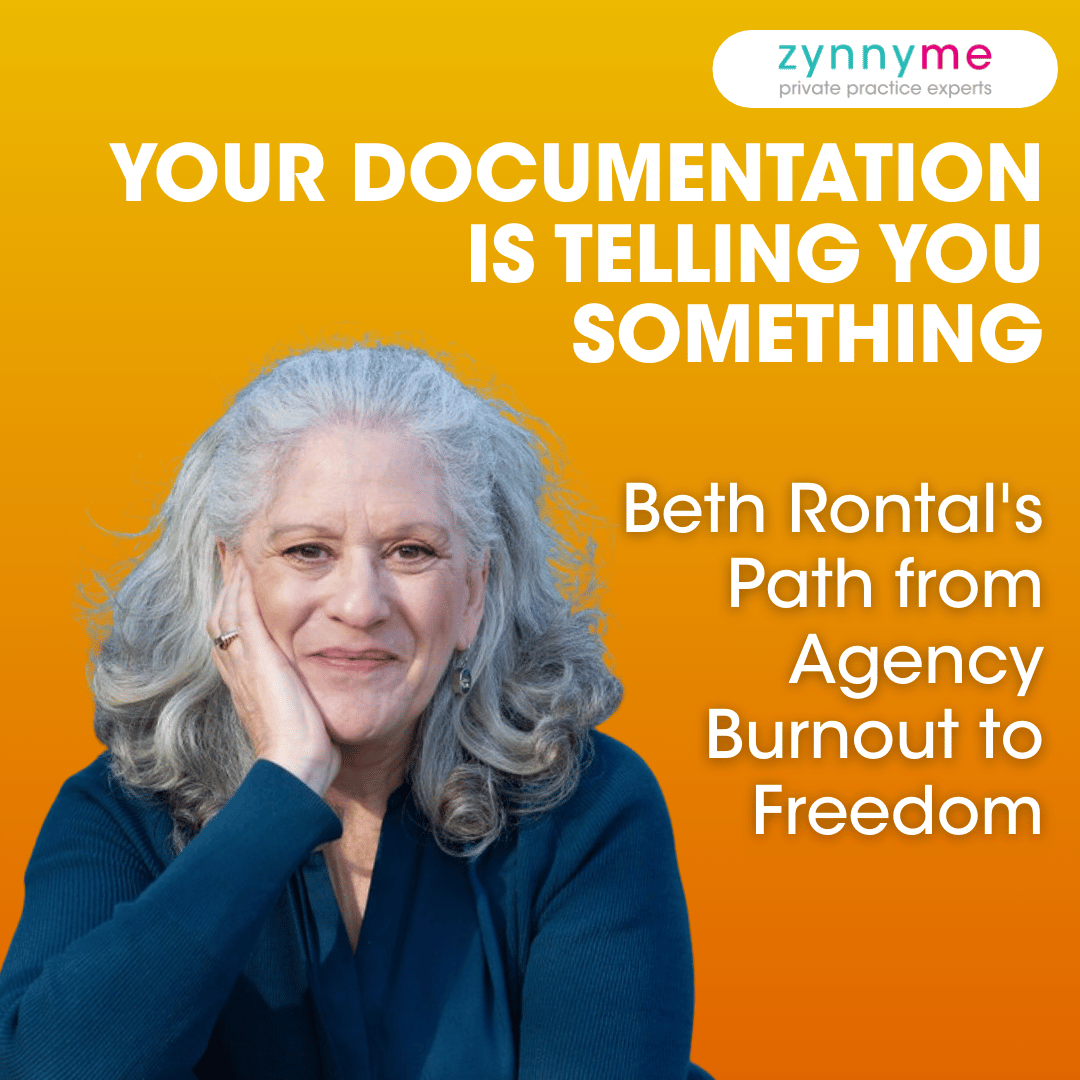
I just had Beth Rontal on the podcast, and honestly? This conversation hit different.
Beth spent 20 years as a costume designer before becoming a therapist. Then she spent 16 years at a community clinic doing home visits with people in the poorest neighborhoods - the kind of work that breaks you open and teaches you what actually matters. Eleven of those years she supervised over 50 clinicians.
Now she runs Documentation Wizard and sees about 9-10 clients a week. And here's the kicker: she actually loves teaching documentation. Like, genuinely loves it.
I know. Stay with me.
Because buried in Beth's story are some things we don't talk about enough in this field - things about sustainability, about what it actually takes to build something that works, and about why so many therapists are drowning in their own practices.
Your Previous Life Wasn't a Waste of Time
Beth didn't take the "traditional" path into therapy. She was designing costumes, managing anxious actors, collaborating with directors, translating someone's vision into something tangible while holding all the emotional chaos that comes with that process.
Sound familiar? Because that's exactly what we do as therapists.
When she applied to social work programs, they rejected her. All three of them. They couldn't see how costume design translated to clinical work. So she did a year of volunteer work to "prove" she was serious, reapplied, and got into all three.
Here's what I want you to hear: The gatekeepers don't always see what you're building. And that's fine. They're operating from a limited framework of what "counts" as preparation for this work.
Your previous career? Your weird path? The thing you did before you knew you'd become a therapist? That's not a liability. That's the foundation of what makes you different in a field full of people who all went straight from undergrad to grad school to licensure.
We're Not Therapy Robots (And We Need to Stop Pretending)
There's this thing that happens in grad school where they teach you to be a "blank slate." To minimize your reactions. To be this steady, neutral presence.
And look - I get the intention. You don't want to be so reactive that your client feels like they have to take care of you. That's real.
But here's what actually happens in the room: Your genuine reaction to someone's trauma - the appropriate shock, the sadness, the anger at what happened to them - can be more healing than any technique you learned in school.
Beth talks about this beautifully - how we bring all of who we are into the room. Our experience, our trauma, our celebrations. All of it. The danger isn't in bringing it. The danger is in being unaware that we're bringing it.
When you're trying to shove down your humanity and act like you're not affected by what you're hearing, your clients feel that disconnect. And honestly? It's kind of creepy. That old image of someone lying on a couch while you sit behind them writing notes? In any other context, we'd call that unsettling.
The relational piece - the "I'm here, I've got you, and also what happened to you is not okay" - that's where healing lives.
Documentation as Clinical Thinking (Not Just Busywork)
Okay, this is where it gets interesting.
Beth was at the clinic when a supervisee got transferred to her. This clinician was about to lose her job because she was so far behind on documentation. They gave her three months and twice-weekly supervision with Beth to catch up.
Most people hate documentation. It's well-earned hatred - insurance companies hide requirements in impossible-to-find policy sections, then penalize you when you don't comply. The exploitation is real.
But here's what Beth figured out: Documentation can actually be a tool for self-supervision and clinical reflection.
When she worked with this supervisee, she mapped out what she calls the "golden thread" - how documentation connects from intake to discharge. The supervisee looked at it and went "oh my god, I get it." She was caught up in three weeks instead of three months.
Now here's the part that matters for your practice:
If you're falling behind on your documentation, your practice is trying to tell you something.
Maybe you're seeing too many clients. Maybe you're not taking enough time between sessions. Maybe you're running over in sessions. Maybe - and this is the one that gets uncomfortable - you have a client who's not a good fit and you're avoiding acknowledging it.
Beth tells this story about having one client whose notes she kept getting behind on. Everything else was up to date, but with this one person she'd be 6, 11 notes behind. It kept happening. Finally she realized: this isn't my highest and best work. I need to refer this person out.
Your documentation backlog is data. Pay attention to it.
The "Side Gig" Myth
Beth thought Documentation Wizard would be a side gig. She launched her first training in 2012 - even before she fully left the clinic. Six people, three Sundays, two hours each.
She loved it. And here's what she learned: When you're genuinely passionate about something, it's almost impossible for it to stay a side gig.
I hear this all the time from therapists: "I want multiple streams of income. I need something that works while I sleep. Something that'll just sell itself."
No. That's not how this works.
If you're building something beyond your clinical practice - whether it's courses, a podcast, trainings, whatever - it's going to require energy. It's going to require attention. It will grow into a whole business if you let it.
The question isn't "how do I create passive income?" The question is: What am I willing to actively build, and what kind of life do I want around that building process?
Beth now has three contractors working with her. She meets with them weekly for two hours to talk strategy. She sees 9-10 clients instead of the 25-30 she used to see. She's deliberate about her energy.
That's not a side gig. That's a business.
Balance Is a Lie (But Rhythms Are Real)
Let's just say it: You're never going to achieve perfect balance.
Some weeks you're pedal to the metal on a deadline. Other weeks you have relative calm. That's not failure - that's how sustainable work actually operates.
The problem is when you're always pedal to the metal. When you've been running at that pace for years. When your body is attacking itself because you haven't given your nervous system a break.
I see this constantly with therapists: chronic illness, autoimmune conditions, bodies that are screaming for you to stop. You're seeing 50 clients a week between your agency job and your BetterHelp side work and trying to launch something else on top of it.
Your body isn't weak. Your body is giving you information.
When you start building practices that actually respect your nervous system - that allow for waves instead of constant flood - symptoms become more manageable. Sometimes they disappear entirely.
Beth's rhythm now: 9-10 clients, Documentation Wizard as her main focus, clear boundaries, hired help for the things she doesn't want to do.
That took 16 years at a clinic to figure out. Don't wait that long.
What Actually Fills a Practice (Hint: It's Not SEO)
Beth filled her practice through:
Her consultation group (where she could show up as her real self)
Professional listservs
Psychology Today profile
Actual relationships with other therapists
She hired someone to do her website and SEO because "this is not my wheelhouse." She knew what she was good at and what she wasn't.
Here's the real talk: There is no shortage of clients. If you're not filling up, it's usually a connection problem, not a marketing problem.
And I don't mean "connection" in some woo-woo way. I mean: Are you in spaces where other therapists actually know you? Where they understand what you're good at and what you're not? Where they can easily refer to you because they've seen your clinical thinking in action?
That's consultation groups. That's professional communities. That's showing up as yourself, not performing some elevator pitch.
Beth calls it "relationship selling" but honestly, it's just being a human who other humans want to refer to.
The Business Models That Are Exploiting You
We didn't have time to fully get into this on the podcast, but Beth and I share the same rage about what's happening with platforms.
Companies like Grow, Rula, Headway - they're taking 30-50% of your session fees. You work as a 1099 contractor (so no benefits, no employment protections) while they maintain operational control. You carry all the legal liability while they capture the majority of revenue.
And therapists are turning to these platforms because agencies pay poverty wages and insurance companies are running AI-driven utilization management to deny claims.
This is systemic exploitation, and we need to call it what it is.
Private practice isn't the only answer - but understanding what you're walking into with these business models matters. You deserve to know what you're actually agreeing to.
What Actually Matters
Look, I'm not going to tell you to "follow your dreams" or that "you've got this."
What I will tell you:
Your weird path counts. Your previous career, your lived experience - that's the foundation of what makes you different.
Your humanity is your best tool. Stop trying to be a therapy robot.
Your documentation tells you things about your practice. Pay attention when you're falling behind.
Nothing passionate stays a side gig. Be honest about what you're willing to build.
Balance is a myth, but rhythms are real. Stop trying to be "on" all the time.
Relationships fill practices. Not SEO panic.
The business models in this industry are often exploitative. Know what you're agreeing to.
Beth's offering free resources on getting your notes done - 25 tips that are actually useful. And if you're dealing with an insurance clawback (or just drowning in documentation anxiety), she does consultations for that.
Check it out at documentationwizard.com.
And if this resonated, let Beth know. Drop a comment on the podcast episode, send her a message, tell her the costume design parallel blew your mind.
We need more therapists who are willing to build things that don't destroy them in the process.
Resources:
25 Tips to Getting Notes Done - Actually useful strategies, not just "set a timer"
Beth’s Website - documentationwizard.com
Business School for Therapists (the community Kelly & Miranda run)
Connect on TikTok for real-time conversations & tips: @zynnyme
Your notes are trying to tell you something. Your body is too. Listen to both
Looking for more wisdom from Kelly & Miranda? Check out their episode archives or join the conversation on TikTok. Big hugs, replenishment, and full slices of cake to you!
About the Authors: Kelly Higdon and Miranda Palmer are the co-founders of ZynnyMe and creators of Business School for Therapists. Since 2010, they've helped tens of thousands of therapists build sustainable practices through organic digital marketing strategies that actually work—without wasting money on ads or time on tactics that don't convert. Because your practice deserves to be found by the people who need you most. Learn more here.