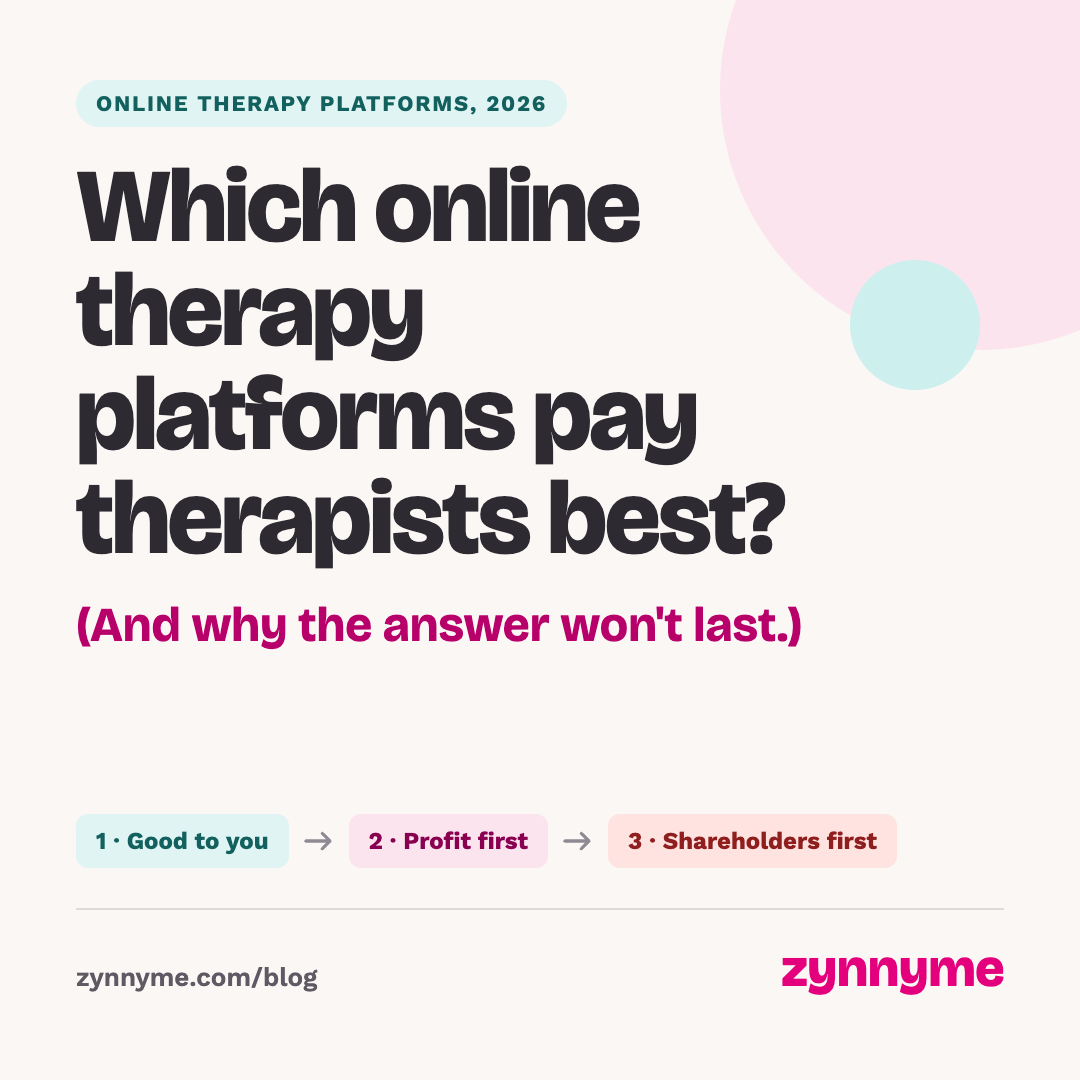
Which Online Therapy Platforms Pay Therapists Best? (And Why It Won’t Last)
Every few weeks, a thread goes up in r/therapists about a platform. Someone documents what happened to them, a hundred people say some version of yes, that happened to me too, and then, reliably, somebody asks the question:
Okay, but what about [other platform]?
We want to answer that question properly, because the honest answer isn't a recommendation. It's that the question has a shelf life, and understanding why will save you more money than picking the right company ever could.
The short version
There is no perfect platform. There is no perfect insurance contract either.
A platform funded by insurance companies cannot protect you from insurance companies. And venture capital cannot take a cut of one of the worst-paid graduate degrees in America and leave you with more money than you started with. The math has never worked. It was never going to.
That first point isn't a metaphor, by the way. Rula's investors include the Blue Venture Fund, which invests on behalf of the Blue Cross and Blue Shield plans. Headway counts Health Care Service Corporation, one of the largest Blue Cross Blue Shield operators, as a strategic investor. Alma and Grow Therapy both have money from Cigna Ventures and Optum Ventures.
What's happened over the past three years isn't a series of bad companies behaving badly. It's a predictable sequence, and once you can see it, you can stop evaluating platforms on their current terms and start evaluating them on where they are in their lifecycle.
So if you came here looking for the best online therapy platform for therapists, or the one that pays best, here is our honest answer: the ranking changes with each company's funding stage. Here's where the major platforms sit as of October 2026, with the full breakdown of each one further down.
At a glance
How the major online therapy platforms compare for therapists (October 2026)
| Platform | How you're paid | Ownership and funding | Insurer-linked investors | Stage |
|---|---|---|---|---|
| Headway | 1099, per session from insurance. A $9.99 per-session fee on marketplace clients rolls out starting October 2026. | Private. $321M+ raised. Last confirmed valuation of $2.38B. | Health Care Service Corporation (a Blue Cross Blue Shield operator) | Two, pre-IPO |
| Alma | 1099, per session from insurance, plus a $125 monthly membership. | Acquired by Spring Health (closed May 1, 2026). Spring Health valued at $3.3B. | Cigna Ventures, Optum Ventures | Two, already acquired |
| Grow Therapy | 1099, per session from insurance. | Private. $150M Series D at a $3B valuation (March 2026). | Cigna Ventures, Optum Ventures | Two |
| Rula | 1099, per session. | Private. $198M to $263M raised, depending on the source. | Blue Venture Fund (invests for Blue Cross and Blue Shield plans) | Two |
| SonderMind | 1099 contractor roles and W-2 roles. | Private. Valued at $1B to $1.57B. | None named in our research | Two, and on the Medicare ACCESS model participant list |
| Lyra Health | Employer EAP benefits. Clients are often routed to W-2 wellness coaches first. | Private. $910M+ raised across eight rounds. | None named in our research | Two |
| BetterHelp | Per session. Therapists report being paid for 45 minutes. | Owned by Teladoc Health, publicly traded on the NYSE. | None named in our research | Three, for ten years |
Pay varies by state, payer, and session code. To see what therapists report being paid on each platform, look it up on TherapistRates.org, and add your own numbers while you're there.
There's a name for the pattern
The writer Cory Doctorow coined the term enshittification in 2022 to describe how platforms decay. The American Dialect Society made it word of the year in 2023, and Australia's Macquarie Dictionary did the same in 2024.
The idea is that platforms move through stages. First they're good to users. Then they're good to their business customers at users' expense. Then they extract from everyone.
What we'd add, after watching this happen to our own profession, is the part that makes it predictable: in mental health, the stage a company is in is driven by where it sits in its funding lifecycle. That isn't a mood or a management philosophy. It's a timeline, and you can look it up before you sign anything.
Stage one: they're good to you, and it's real
It helps to start with what "funding" actually means, because most of us hear the word and picture something that has been proven out.
A venture-backed company raises money on a vision. Not on a track record, not on a working business, and in most cases not on anything that has been built yet. These companies are often founded by self-described disruptors who say they see a better way to deliver mental health care, and who have little or no experience actually delivering it. With the right pitch deck and the right marketing, that is enough to raise tens of millions of dollars before a single therapist has been paid.
And they do it more than once. Grow Therapy raised $15 million in its first round, $75 million a year later, and $88 million after that, all within four years of founding. Headway raised $26 million, then $70 million, then $125 million. Lyra Health has raised more than $900 million across eight rounds. Most of these companies go through several rounds of funding during stage one alone.
That money has to be spent on something. In the beginning, it gets spent on you.
When a venture-backed company launches, it needs therapists. Lots of them, quickly, before a competitor gets there.
So the offer is genuinely excellent. Credentialing handled. Billing handled. Steady referrals with no marketing plan required. Rates that compare well to doing it yourself, and sometimes rates that are better.
None of that is false, exactly. You have to be good to users to get users, and investor money exists to fund exactly that generosity before anybody asks about profitability.
Which means: if you joined a platform during stage one and it was great, you weren't naive. You were early.
Here's a therapist describing that arc on the Alma thread:
"They tend to give you clients when you first sign up then there's a drop off. You'll have to get your own clients anyway, may as well start off doing so."
And another, on the same thread:
"They used to be solid in 2023 but have gone way down hill."
Solid in 2023. That's stage one with a date on it.
This is also the stage where we wrote what to ask a recruiter before signing a platform contract and what every therapist should know before signing with a mental health tech company. The contracts told you what was coming. They just didn't put it in the recruiting email.
And a quick word about recruiters.
Many platform recruiters are paid based on whether you sign. That is the entire job: not matching you well, not making sure the fit is right, just getting the signature. Which means the person describing the platform to you has a financial stake in your yes and carries no responsibility for what you find out in month three.
So if you were promised one thing, signed on the dotted line, and then discovered the reality was something else, that is a known pattern rather than a failure of due diligence on your part.
Here's how far it has gone. BetterHelp has recruited through Gotham Enterprises, a third-party recruiting firm, and therapists have documented not being told which company the job was actually for. One therapist got partway through a second Zoom interview before the recruiter shared his screen and a BetterHelp platform page appeared on it. She had asked directly, at the start of that call, who she was interviewing with, and had read him an email from his own firm stating they were recruiting on behalf of someone else.
"Guy told me he didn't disclose bc they had an NDA with betterhelp."
Another therapist in the same thread:
"Similar experience for me a year or so ago with a company listed as 'Gotham' that turned out to be a BH recruiter. Noped out of that real quick."
And the comment that puts it best:
"Bad sign when your therapy company has such a bad rap they need to come up with a Batman-style alias to trick people to apply."
One more detail from that thread, because it rhymes with the Grow Therapy story further down: the recruiters built a BetterHelp profile for the therapist from their end, using a photo they pulled off her Psychology Today listing. She had to tell them to delete it.
The pitch itself is worth reading too. One therapist saved the recruiting email, which promised "Competitive Compensation: 40 hours per week = $100K+ per year and health stipend." A commenter did the arithmetic the email left out: sessions are 45 minutes and paid by the session, so reaching 40 paid hours means seeing closer to 50 clients a week. We'll come back to that number.
🚩 Three things worth asking before you take a recruiter call
📄 What is the legal entity name on the contract? If the name on the contract isn't the name in the email, find out why before you go any further.
💰 Are you compensated based on whether I sign? Most people will answer honestly, and the answer tells you how to weigh everything else they say.
🔍 Is everything you just told me written into the contract? Rates, caseload expectations, referral volume, what happens when you leave. If it only exists in the pitch, it isn't a term. It's a mood.
Stage two: they focus on being profitable, to sell or go public
Here's where the rules start to change. Rounds of millions of dollars stop being the point, and investors get a lot pickier about writing checks after the first few.
A venture-funded company eventually has to produce a return. That means an IPO or an acquisition, and both require the metrics to look right to people doing serious due diligence. Margins have to improve. Profitability has to go up.
In practice, that can look like:
📉 Passing on the cost of clawbacks they told you they would absorb
✂️ Cutting your reimbursement rate
🤐 Leaving your rate exactly where it is while they negotiate higher reimbursement for themselves
🤖 Using session and chat transcripts to train AI therapy chatbots they can raise money on or sell directly to consumers
🎧 Signing up coaches to provide interim care at a fraction of what a licensed clinician costs
📱 Pushing app-based and chatbot care while the payment rules shift to reward exactly that
📝 Changing your documentation requirements, or changing how your pay gets calculated
Two of those have stopped being hypothetical. Endpoints News reported that Talkspace and Lyra Health train their chatbots on real therapy session transcripts, while competitors including Headspace and Jimini Health use synthetic data instead.
And on July 5, 2026, CMS launched the ACCESS model, short for Advancing Chronic Care with Effective, Scalable Solutions. It's a ten-year voluntary Medicare model built around "technology-supported care," which the agency describes as including telehealth, wearables, apps, and authorized software. One of its four opening tracks is behavioral health, covering depression and anxiety, with substance use disorder and tobacco cessation tracks planned for 2027. Participants are paid through recurring outcome-aligned payments, where full payment depends on the share of patients who hit measurable outcome targets rather than on the services actually delivered. Early participants are describing it as an accelerant for value-based care in behavioral health.
And here's the part worth knowing before you read any further: the participant list is public, and SonderMind is on it three times over. SonderMind, P.C., Sondermind, P.A., and Sondermind Provider Network, all three under the behavioral health track. Headspace is on the list too, as Headspace Medical Group CA P.A. Roughly 165 organizations have been accepted so far, and CMS notes that inclusion isn't an endorsement.
Now hold that next to the SonderMind section further down in this piece, where former contractors describe AI rating their notes before submission against the company's quality controls. A company already running automated review of clinical documentation has signed up for a Medicare model that pays based on the share of patients hitting outcome targets. Those two facts belong in the same sentence, and this is that sentence.
And hold it next to one more thing, from the research section below: 86% of therapists surveyed said they would leave a platform that moved them from per-session pay to a value-based model. Medicare has built the lane, and the companies are already in it.
That improvement comes out of the largest flexible cost in the business, which is what the company pays clinicians. Not because anybody at the company dislikes therapists, but because you're the line item with the most give in it.
There are very smart people inside these companies working full time on how to turn the data and the infrastructure they've built into profit. None of that work is about how to keep you.
This is where almost every company in our field is right now. Not one or two. The whole category, on roughly the same clock.
We called this one moldy crumbs disguised as easy bread and butter.
And here's a structural wrinkle worth understanding
Under the Affordable Care Act, insurers can't keep everything they collect. They have to spend 80 to 85 cents of every premium dollar on actual medical care and quality improvement, or rebate the difference to customers. Profit on the insurance side has a legal ceiling.
That ceiling applies to the insurance company. It does not apply to a company the insurer happens to own.
When an insurer pays a claim, that's medical expense and it counts toward the ratio. When that payment lands at a subsidiary the same parent owns, it becomes revenue. Revenue in a subsidiary has no cap.
This isn't hypothetical. UnitedHealth's provider arm, Optum, has become larger and more profitable than its insurance business. Owning the care is where the unconstrained money is.
Is that why insurance companies are investing in therapy platforms? We genuinely don't know. We're not going to tell you we've found a smoking gun, because we haven't.
What we'd say is this: we've thought about it from a lot of angles, and we cannot construct a version where the goal is paying therapists more or eliminating clawbacks. If an insurer wanted to do either of those things, they could simply do them. They already know how. They've built those systems inside the platforms they fund.
So the question isn't whether insurers can improve credentialing, payment speed, and clawback risk. They've proven they can. The question is why those improvements only exist inside companies they have a financial stake in.
Which means stage two might not be "they're looking for a buyer." The buyer may already be sitting at the table.
Stage three: the duty changes
Once a company is publicly traded, something shifts that has nothing to do with intentions. The board's legal duty runs to shareholders. Not to clinicians, not to patients. An executive who prioritizes provider wellbeing over quarterly returns faces real consequences from investors, and those investors have more lawyers than you do.
That's not cynicism, it's corporate structure. It's also why appealing to a public company's better nature has never once worked.
If you want that duty stated out loud, look at what happened to UnitedHealth. After the killing of UnitedHealthcare CEO Brian Thompson in December 2024, the company's own investors sued it. Their complaint was not that the company had treated patients badly. It was that the company kept its 2025 earnings guidance in place when it should have known those numbers were out of reach, because, as NBC News reported, the public backlash had prevented it from pursuing "the aggressive, anti-consumer tactics that it would need to achieve" its earnings goals.
Read that twice. Shareholders went to federal court arguing they had been misled, and their explanation for why the targets became unreachable was that the company could no longer be aggressive enough toward the people it insures. The filing treats anti-consumer tactics as the ordinary, expected method of hitting a number. UnitedHealth denies wrongdoing and says it will defend the case.
That is what fiduciary duty to shareholders looks like when somebody writes it down.
This is where the insurers already live. And it's where several of these platforms are headed.
How the major online therapy platforms compare for therapists (October 2026)
What follows is funding status, current stage, and what therapists are actually saying. We've linked the threads so you can read them yourself rather than taking our characterization of them.
Headway
Status: Private. Founded 2019. $321 to 325 million raised. Last confirmed valuation of $2.38 billion. Series A $26M (late 2020), Series B $70M (May 2021), Series C $125M (October 2023), Series D $100M (July 2024).
Key investors: Spark Capital, a16z, Accel, Thrive Capital, Forerunner, GV (formerly Google Ventures). And Health Care Service Corporation, one of the largest Blue Cross Blue Shield operators, as a strategic investor in the Series C.
Stage: Two, and moving. Still pre-IPO.
What changed: Headway's founding pitch was explicitly that it charged therapists nothing and took its commission from insurers instead. In October 2026 it began rolling out a $9.99 per session fee for referrals, regardless of your reimbursement rate. (We wrote about that here.)
That's not a price adjustment. It's a documented reversal of a stated policy, and it's the clearest stage-two marker in the field.
What therapists report: The thread worth reading is "My Headway Nightmare", 172 upvotes and dozens of corroborating replies. The author describes four months and two Better Business Bureau complaints to get an account deleted, and a sales rep whose pitch included "if you don't get your first Headway client by X date, you no longer have access to your sales rep."
Their read on why deletion was so hard:
"They tell providers they will be deleted but never do it to keep their inflated active user KPIs trending upwards since they need PE/VC funding."
Several replies confirmed the pattern, including one noting that deleting your account and deleting your public directory profile are two separate requests.
This matters more than it sounds. A profile you can't remove means your name and license keep working as marketing for a company you've left. You're generating searches, building the directory's credibility, and feeding referrals that get routed to somebody else.
It also actively damages your own practice. When a prospective client googles you, they land on a listing saying you take their insurance through a platform you're no longer on. You look unavailable, or disorganized, or like you've gone quiet. You never hear about the ones who gave up at that point.
Ghost networks, where directories list providers who aren't actually available, are drawing regulator attention. If you're listed somewhere you've left, filing with your state Department of Insurance with proof is a real option.
The single most important technical detail in the thread, though, is this one:
"Platforms advertise 'Fast Credentialing' because it is not true credentialing. The platforms have what is called a delegated credentialing agreement in which the providers are credentialed by the platforms and not the insurance companies themselves. The caveat is that it does not follow you once you leave the platform."
If you understand nothing else about these companies, understand that. The credentialing you think you're acquiring isn't yours. You're renting it.
Also reported: self-contracted rates running $5 to $10 higher per session than platform rates, an inability to suppress your profile from the platform's search results, and clients being charged copays higher than their plans specified.
One more thing worth knowing: Headway is facing a class action over allegedly disclosing patient information to Google. The suit alleges that Google Analytics code embedded on Headway's site passed users' mental health information to Google without their consent. In September 2024, a federal judge in California denied most of Headway's motion to dismiss, letting the invasion of privacy claims and the California Invasion of Privacy Act aiding-and-abetting claims proceed while dismissing others. Headway called the ruling a substantial victory on the claims that were dismissed. The case is ongoing.
GV, formerly Google Ventures, is a Headway investor.
Alma
Status: Private, now under Spring Health, which acquired it in a deal announced January 2026 and closed May 1, 2026. Over $220 million raised before the acquisition, valued around $800 million as of August 2022. Spring Health raised $100M at a $3.3 billion valuation and is widely expected to pursue an IPO.
Key investors: Thoma Bravo, Insight Partners, Tusk, Primary, Sound Ventures, First Round. Plus Cigna Ventures and Optum Ventures.
Stage: Two, with an acquisition already executed. Which means the squeeze now serves a parent company's exit, not just Alma's.
What therapists report: The "Thoughts on Alma?" thread is more measured than the others, which is useful.
"Alma's on the decline now with their decrease in reimbursement rates and fearmongering around 'extended sessions' (90837). It's not worth it anymore. When I was accepting clients on their platform for about a year, I barely got any clients who found me through them."
That 90837 point deserves attention. Pressure on extended session codes is pressure on clinical decision-making, applied through a billing mechanism.
But the thread also contains a genuinely positive account, and we're including it because a page that only prints complaints isn't research:
"As someone who doesn't pay for a biller, it still has value for me in the ease of submitting claims and getting paid on a regular basis without worrying about denied claims or clawbacks. I'll use it until it doesn't work for me anymore and there is no penalty for taking clients off the platform somewhere else."
That's a clear-eyed user making a deliberate trade with an exit planned. It's a reasonable position. It just isn't the same as believing the platform is on your side.
And the best description of the trade anyone has written:
"Alma takes the scary part off your plate, but it does that by taking over the business. Join it and you're less an owner and more a gig worker, like an uber driver: they set the terms, they take a big cut you don't see up close, and your income runs on rules you don't control."
Grow Therapy
Status: Private and independent. Founded 2020. $178 million raised as of October 2025, plus a $150 million Series D in March 2026 at a $3 billion valuation. Series A $15M (Sept 2021), Series B $75M (Sept 2022), Series C $88M (April 2024), Series D $150M (March 2026).
Key investors: Sequoia Capital, Goldman Sachs Alternatives, TCV, Transformation Capital, SignalFire. Plus Cigna Ventures and Optum Ventures. Also a notable roster of celebrity and athlete investors including Anna Kendrick, Lily Collins, Dak Prescott, and Joe Burrow.
Stage: Two. A $3 billion valuation creates an obligation to eventually justify $3 billion.
What therapists report: The "BEWARE OF GROW THERAPY" thread hit 243 upvotes and describes something categorically different from poor service.
A therapist applying for their own individual insurance credentialing discovered that a Grow Therapy credentialing staffer had amended their individual application to list herself as the point of contact. The therapist's interpretation:
"That only points in one direction, that she would direct the insurance to deny my individual application since I'm already on their group application. This is pure sabotage to try to keep clinicians stuck working on their platform."
Other reports in the thread: being blocked from contacting support without notification, discovered only via LinkedIn. A Psychology Today profile created for a therapist without her involvement, auto opted-in, ranking above the one she pays for. A contract cancelled over documentation style, requiring the therapist to refer out 32 clients.
Multiple therapists in that thread reported being asked for their CAQH login credentials during onboarding. You should never give those out. One commenter who refused was offered view-only access instead, which worked fine. As a practice manager in the thread put it: your CAQH is your professional social security number.
Rula
Status: Private. Founded 2019 as Path Mental Health. Reported totals vary by source, from $198 million (PitchBook) to $263 million (Sacra), which itself tells you something about private-market transparency. Series C of $125 to 143 million in July 2024, led by Hedosophia.
Key investors: Hedosophia, Sequoia, Wing, Upfront, Icon, Koch Disruptive Technologies. Plus the Blue Venture Fund, which invests on behalf of the Blue Cross and Blue Shield plans, and GS Futures.
Stage: Two.
What therapists report: The thread on Rula is smaller but specific. A therapist was promised a $90 flat fee regardless of insurance and paid $65 for her first session. She was told during recruitment she could decline one insurer she was already contracted with independently, and later told she "cannot cherry-pick." A $500 referral bonus wasn't honored because the platform had no record of the link she'd used to sign up.
Also noted in that thread and elsewhere: Rula records session minutes.
And from a commenter on a different thread, the arithmetic in one line:
"Rula is billing a major insurance company now over 100, and when I tried to get on their panel they offered me 40."
SonderMind
Status: Private. Founded 2014, Denver. $183 to 276 million raised depending on source. Valued at $1 to 1.57 billion, reaching unicorn status in 2021. Series C $150M in July 2021, co-led by Drive Capital and Premji Invest.
Stage: Two.
What therapists report: The SonderMind thread is worth reading for the full-time W-2 numbers alone. A therapist who interviewed reported the offer as $75,000 for 25 sessions a week, scaling to roughly $129,000 only at 38 sessions a week, with required early mornings or evenings.
Her response: "I told them that if I wanted to see 38 clients per week, I'd be aiming for a lot higher than $129k."
Former contractors describe slow referrals, support reachable only by ticket with weeks-long response times, and no phone number. One reports that AI now rates your notes before submission against the company's quality controls. Another describes being told the company had no record of her employment when she needed verification, and nearly losing a home closing because income documentation took weeks.
And as noted up in stage two, SonderMind appears three times on the CMS ACCESS model participant list, all three entries under the behavioral health track.
Lyra Health
Status: Private. Founded 2015. $910 to 915 million raised across eight rounds, the largest war chest in the group. Last round $235M Series F in January 2022, led by Dragoneer. EAP rather than insurance panel, which changes the shape but not the pattern.
What therapists report: The "Lyra Health: A Rant" thread raises a clinical safety issue, not just a business one. The author describes clients presenting with active intent, plan, and means being scheduled for outpatient virtual sessions, with referral-back requests submitted twice and never acknowledged. Support is primarily an AI chatbot.
A former employee's description:
"Lyra Health is fintech using mental health as a product. As a former employee: if you are a clinician and value doing your work properly, you will not be able to do so there."
And a detailed account of the current structure: most clients routed first to W-2 wellness coaches in half-hour slots, with licensed therapists carrying 30 bookable slots and facing termination for not maintaining open availability. The rate at which a therapist refers clients out is tracked and can count against them in reviews.
BetterHelp
Status: Owned by Teladoc Health, publicly traded on the NYSE. Founded 2013, acquired by Teladoc in January 2015 for $3.5 million in cash, a $1 million promissory note, and 15% of sales for three years.
Stage: Three, and has been for ten years. Which makes it the clearest available look at where everything else is heading.
What that means in practice: every decision about therapist compensation at BetterHelp has been made inside a company with a legal duty to shareholders and a quarterly earnings call. Not a startup weighing growth against goodwill. A public company with analysts asking about margin.
What therapists report: The thread is "BetterHelp's manipulation", 396 upvotes.
The original post documents something precise. BetterHelp only allowed therapists to bill 45-minute sessions, which meant seeing more clients to hit hour requirements. Now that the company accepts insurance, it's marketing the fact that "some conversations take more than 45 minutes."
"It's just hilarious that they're trying to package this as something amazing they've done for clients and clinicians when really it's about their bottom line and they never gave a crap about 'longer conversations' before they accepted insurance. And note: only insurance clients get longer sessions. Cash pay clients, you got 45 minutes so talk quick."
The thread then produced the arithmetic. A certified medical coder in the comments pointed out that CPT 90837, the standard therapy hour, requires 53+ minutes. Another therapist reported having it in writing that BetterHelp pays only for the first 45 minutes, though it can bill for the extra time.
A third did the math out loud:
"Wait, wait, wait, let me get this right: if a therapist on BH meets with a client for a 'therapy hour' (53+ mins), the therapist only gets paid for 45m, the client gets charged for the hour, and BH pockets the difference?"
Other descriptions from the thread:
"BetterHelp puts all the risks on therapists while they get all the benefits of a 'group practice.' It is Silicon Valley's answer to figuring out how to make therapy a product."
"We are just burger flippers to them. They said they're 'disrupting' the market but what that means is disrupting our rights to be valued."
"BetterHelp is the puppy mill of the mental health industry."
And one that illustrates the gap between the people making these decisions and the people living with them. A therapist described a company town hall where the CEO mentioned that "one of" their homes had burned in the California fires, but they were hanging in there. Same quarter the clinicians were told their workload was increasing and their bonuses were being cut.
On the client side, from a therapist who picked up someone who'd been through two BetterHelp clinicians: the client said they covered more ground in one session than in all their BetterHelp sessions combined.
What the research says therapists actually think
In spring 2025, the Psychotherapy Action Network surveyed 667 mental health professionals about these companies. The gap between what therapists say and what they know is the most useful finding in it.
85% said they would not use a practice management company if they knew an insurance company held a large ownership stake. 70% don't know who owns these platforms. Among therapists actively using one, 71% don't know.
84% were never told the fee-splitting arrangement, meaning what the company collects per session versus what it pays you. As PsiAN points out, nobody would join a traditional group practice without asking that question.
On money: 52% report earning more through a platform, 18% about the same, and 32% less. So roughly half earn the same or less than they would independently, which is the thing the entire value proposition rests on.
On privacy: 96% rate client privacy as extremely important. 81% of platform users don't believe their platform adequately protects it.
On what would make them leave: 86% said they'd stop if the company introduced a value-based payment model instead of paying per session. PsiAN reports that Headway already has a value-based payment pilot running. Add in the Medicare ACCESS model we covered up in stage two, which pays on outcome targets rather than services delivered, and the picture is clear enough: the payment model that 86% of therapists say they'd walk over is the one the system is actively building toward.
And adoption is lower than most people assume. Only 17% of respondents currently use a platform. Of the 83% who don't, only 12% are open to it.
What the rates actually look like
Here's a resource more therapists should know about: therapistrates.org is a crowdsourced database of what therapists are actually paid, broken out by platform, by state, and critically, comparing platform rates against direct insurance contracts.
You can look up a specific platform directly, for instance Alma's page here.
Two honest caveats. It's at roughly 700 entries, which is thin, so treat it as directional rather than definitive. And it only gets better if people contribute. If you're on a platform or hold direct contracts, add your numbers. This is the kind of thing that only exists if we build it ourselves, and the information asymmetry between you and a company with a pricing team is the entire problem.
One more frame worth having
A while back we adapted the Duluth Power and Control Wheel for insurance companies and therapists, because the dynamics kept looking familiar in a way we couldn't unsee.
Isolation. Economic control. Minimizing and denying. Shifting blame onto the person being harmed. Rules that change without notice and explanations that never quite arrive.
We didn't write it to be provocative. We wrote it because clinicians are trained to recognize these patterns in other contexts, and that training turns off when the pattern is aimed at us. Reading the threads above with that wheel in mind is clarifying, and occasionally uncomfortable.
So what do you actually do?
Five things, none of which require blowing up your practice this month.
Know the stage before you sign
Find out where the company sits. Newly funded and buying market share? Late-stage private, visibly preparing to sell or list? Already public, or owned by someone public?
This is findable. Funding rounds are press releases. Acquisitions are reported. Twenty minutes of searching tells you more about your next three years than any review will.
And once you know the stage, you know roughly what's coming. A stage one company will be generous and then stop. A stage two company will tighten terms on a schedule set by its investors. A stage three company is legally obligated to prioritize something other than you.
Understand what they're optimizing for right now
Companies telegraph this. Aggressive clinician recruiting means they're buying supply. A new head of investor relations, or a CFO with public-company experience, means they're preparing to exit. What they're optimizing for today tells you what changes next quarter.
Let go of the dues-paying frame
This one is hardest, because most of us were trained into it.
In agencies and hospitals there was at least a theory: put in your time, prove yourself, get noticed, move up. Whether or not it worked, the structure existed.
Platforms have no such structure. There's no tenure. Loyalty doesn't accrue. Nobody is tracking that you've been excellent for three years and preparing to reward it. Your rate is set by a formula that optimizes for the company's margin, and it changes when the margin needs it to, regardless of your outcomes or your reliability.
Waiting to be recognized by a platform is waiting for something the system has no mechanism to deliver.
Know the difference between a contractor and an employee
This is the practical protection almost nobody mentions.
The federal standard applies to everyone. The IRS uses common law rules to determine whether someone is an employee or an independent contractor, and they look at three categories:
Behavioral control. Does the company direct or control how you do the work? Who sets your schedule? Are you told what sequence to follow, what tools to use, how to document? Is there required training on company procedures?
Financial control. Who controls the business side? Who sets your rate? Can you realize a profit or a loss? Are you free to offer your services to other companies and to the open market?
Type of relationship. Is there a written contract, and does it match reality? Are there benefits like insurance, pension, or paid leave? Is the relationship open-ended rather than project-based? And is the work you perform a key aspect of the company's regular business?
That last question matters more than people realize. A therapist providing therapy for a therapy company is performing the company's core business, not an outside service.
The IRS is explicit that no single factor decides this, and that you weigh the entire relationship. Critically, the label on the contract doesn't control the answer. What controls it is how the relationship actually functions.
Some states apply a stricter test on top. California, Massachusetts, New Jersey and others use the ABC test, often for unemployment insurance purposes. Under it you're presumed to be an employee unless the company proves all three: that you're free from its control, that your work falls outside its usual course of business, and that you're independently established in that trade. That middle prong is deliberately hard for a therapy company to satisfy when the worker is a therapist. Check whether your state uses it.
And run the actual numbers, not the headline number
Remember that recruiting email promising "$100K+ per year" for 40 hours a week? That's the number that gets people to sign. It's also the number that tells you the least.
A 1099 session rate and a W-2 salary are not comparable figures, and the gap between them is wider than most of us assume. Before you weigh a platform offer against a staff job, or decide whether to stay on a platform that's entering stage two, put all of this on the contractor side of the ledger.
Self-employment tax. As a W-2 employee you pay 7.65% toward Social Security and Medicare and your employer pays the other 7.65%. As a 1099 contractor you pay both halves, 15.3% of your net self-employment income. You can deduct half of it on your return, which softens the hit, but the cash still leaves your account.
Hours you work versus hours you get paid for. Platforms pay per session, not per hour. Documentation, intakes, coordination, insurance follow-up, and the dead hour when somebody cancels at 3pm are all unpaid. If sessions run 45 minutes and you're paid by the session, "40 hours a week" does not mean 40 appointments.
No-shows and cancellations. On salary, a cancellation is a quiet hour. On piece work, it's a pay cut.
Time off. A salaried job with three weeks of vacation plus holidays pays you for roughly 52 weeks while you work about 48. A contractor earns nothing during those four weeks, so the weekly rate has to run about 8% higher just to tie.
Benefits you'd otherwise buy yourself. Health insurance premiums, retirement match, disability coverage, workers' comp, malpractice, licensure fees, CEs, supervision. Price the ones you actually need rather than the whole list.
Unemployment insurance. This is the one that matters most in stage two. A W-2 employee whose hours get cut or whose position disappears can generally file for unemployment. A 1099 contractor usually cannot. So when a platform changes your rate, your documentation requirements, or your referral flow overnight, there's no cushion under that and no notice period either. The flexibility runs in one direction.
There's no single multiplier that converts one into the other, because health insurance alone can swing the answer by tens of thousands depending on your state, your age, and whether you're on a spouse's plan. Which is exactly why it's worth running with your own numbers.
🧮 A prompt for running your own comparison
"I'm a licensed therapist in [state]. Compare two options for me, both as take-home pay and as total compensation.
Option A, 1099 platform work: [rate] per session, sessions are [45 or 53+] minutes, I expect [number] sessions a week for [number] weeks a year, my no-show and cancellation rate runs about [%], and the platform contributes [nothing, or an amount] toward benefits.
Option B, W-2 position: [salary], [number] weeks of paid time off plus holidays, health insurance at [employee premium] a month, [retirement match], and [any CE, licensure, or malpractice coverage included].
For Option A, account for the full 15.3% self-employment tax including the deduction for half of it, my unpaid admin and documentation time at roughly [number] hours a week, and what I would pay on the open market for the benefits Option B includes. Give me the effective hourly rate for each option counting every hour I work, not just billed sessions. Then tell me what session rate Option A would have to pay to match Option B, and what I would be giving up that doesn't show up in the numbers at all, including unemployment eligibility."
Check the tax figures and the insurance quotes against a CPA or your state's marketplace rather than taking an AI's word for either. But ten minutes with that prompt will get you to a real comparison, and the real comparison is usually a very different conversation than the one the recruiter was having.
And if you're staying for now, here's what to do with that time
Plenty of people reading this can't leave this month. Rent is due. The caseload is what it is. That's real, and we're not going to pretend otherwise.
If that's you, there's something useful you can do from inside: document what's happening.
There's a form for this, and you can file it yourself
IRS Form SS-8, "Determination of Worker Status for Purposes of Federal Employment Taxes and Income Tax Withholding," lets a worker ask the IRS to officially determine their classification. You don't need the company's permission and you don't need an attorney.
Two honest caveats. These determinations take a long time, often many months and sometimes longer. And the company is notified and given a chance to respond, so it isn't anonymous.
There's also Form 8919, for workers who believe they were misclassified and are paying the employer's share of Social Security and Medicare that shouldn't be theirs. That one has real money attached, since misclassification means you've been covering roughly 7.65% an employer would otherwise owe.
But start with your state
State labor agencies generally move faster than the IRS on misclassification, often considerably faster. They also have more direct enforcement tools: wage claims, unemployment insurance determinations, and in some states penalties that actually bite. Many states let you file online in under an hour, without an attorney, and some let you file a wage claim and a misclassification complaint at the same time.
Start there, and file federally as well if you want both tracks running. Retaliation for filing is unlawful either way.
And here's one genuinely good use of AI
Everything else in this piece has been about AI being used on therapists: trained on your notes, reviewing your documentation, replacing your sessions. Use it in the other direction.
Open whichever AI tool you prefer and ask it to help you figure out your specific situation. Something like:
"I'm a licensed therapist in [your state] working as a 1099 contractor for a telehealth platform. Here's what the arrangement actually looks like: [describe the control, the scheduling requirements, the rate-setting, the documentation rules, whatever applies]. Does my state use the ABC test or a common law test? Which agency handles worker misclassification complaints here? What's the filing process, what's the typical timeline, and what documentation should I gather first?"
You'll get a starting map in a few minutes instead of a weekend of searching. Verify what it tells you against your state agency's actual website, because these tools get details wrong and the stakes here are yours. But as a way to go from "I don't even know where to begin" to "here is the agency and here is the form," it's genuinely useful.
So keep a record
Screenshots and dated notes of:
Required schedule availability, and what happens if you don't meet it
Session minutes tracked or recorded
Required documentation formats, and AI review of your notes
Caseload minimums or referral-rate metrics held against you
Restrictions on seeing clients outside the platform
Mandatory trainings or meetings
Rate changes imposed without negotiation
Any communication telling you how to practice rather than what the contract requires
You might never file anything. But the documentation costs you almost nothing, and it means that if you do decide to, or if a regulator or a journalist or an attorney comes looking, the record exists.
One more thing worth saying. The therapists who posted in those threads, naming companies and describing what happened with dates and specifics, are the reason anyone can research this at all. That's not complaining. That's a profession documenting its own working conditions, which is the first step every group of workers has ever taken before anything changed.
We're not attorneys and we're not telling you your particular situation is unlawful. We're telling you the tests are public, your experience is evidence, and you're allowed to write it down.
The choice isn't platform or solo
Here's where a lot of this conversation goes wrong, including when therapists have it with each other.
Somebody says "stop working for these companies." Somebody else says "that's easy to say when you have a safety net." Both people are right, and the conversation stops there, usually with everyone more tired than when it started.
So let's be concrete, because there are more than two doors.
There are still W-2 jobs. Community mental health. Hospitals. Schools. Universities. VA and other government positions. Nonprofits. Group practices that classify people correctly and pay for it. These come with health insurance, paid time off, retirement contributions, workers' comp, and somebody else carrying the business risk.
They are not glamorous and the pay ceiling is real. But if what you need right now is a predictable paycheck and benefits while you're caring for a parent, recovering from burnout, or getting through a divorce, a W-2 job is a legitimate answer and nobody should make you feel bad about it. It is categorically different from being a 1099 contractor for a company that controls your schedule, your rate, and your documentation while providing none of that.
There are still good group practices. Smaller, local, owner-operated, where you know the person signing the checks. They have their own problems; ask anyone who's worked in one. But the owner is a therapist, the scale is human, and you can ask questions and get answers from a person.
And there's building your own. Which is harder at the start and compounds afterward. You set the rate. You choose who you work with. Your credentialing is actually yours. Your reputation accrues to you. When a company three states away changes its fee structure, it isn't your problem.
What we'd push back on is the idea that platforms are the only alternative to solo practice. They're the most advertised alternative, because they have enormous marketing budgets and the others don't. That's not the same thing.
The thing we most want you to consider
Every time one of these threads goes up, the replies fill with what about this other one.
We understand the impulse. Getting clients is hard. Marketing feels uncomfortable for a lot of clinicians. Insurance billing is a genuine nightmare. The hope that somebody has solved it and will hand you the solution for a reasonable cut is a very human hope.
But look at what you're hoping for. A platform funded by insurance companies cannot protect you from insurance companies. And a venture-backed business cannot take a percentage of one of the worst-compensated graduate degrees in the country and leave you better off. There is no version of that arithmetic that works. The cut has to come from somewhere, and the only somewhere is you.
Here's the part that we think gets lost entirely.
There is a shortage of mental health providers in this country. Not a glut. A shortage, documented repeatedly, in nearly every state.
You are not competing for scarce work in a crowded field. You are a scarce resource in a market that needs far more of you than exists. And yet therapists routinely accept terms that only make sense for someone with no alternatives, in a profession where the actual constraint is that there aren't enough of us.
PsiAN put the structural version of this plainly:
"The insurers have manufactured this therapist shortage, which is advantageous to them; the fewer therapists that insurers have to deal with and the fewer therapy sessions they have to pay for, the more profitable they will be."
That's the thing worth sitting with. Not whether Grow is better than Rula this quarter. Whether you've been pricing yourself like someone who's hard to replace, because clinically and practically, you are.
Building your own takes longer at the start and compounds afterward. It's harder. We won't pretend otherwise. But it's harder in a way that's finite, rather than harder in a way that gets worse every quarter.
Where to start
If you're ready to plan an exit, here's our year-end checklist for building your platform exit plan. Free, no opt-in.
If you're earlier and still working out whether you can build something independent at all, we run a free training on starting a private practice from scratch.
And if you already have a practice that isn't working financially, which is the most common situation we see, there's a free training on increasing profits by $10,000 or more while working less.
If you're on a platform now and want to know what your contract actually allows, our free platforms training walks through it.
Wherever you are, the question worth asking isn't which platform is best right now. It's what you want to have built by the time the current one changes its terms.