The Importance of Mentorship and Culture from a Successful Texas Group Practice Owner
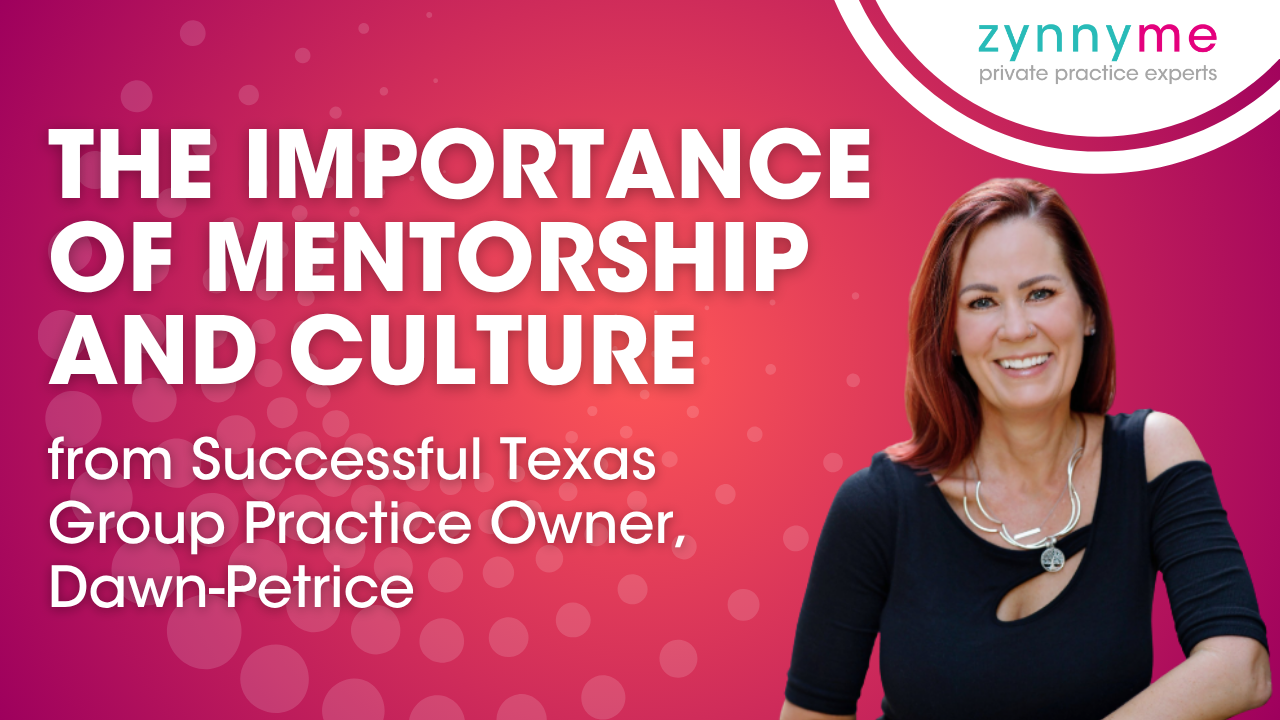
So, you’re thinking about starting or growing a counseling practice. Maybe you’re a solo therapist staring wistfully into your future, picturing a thriving group, collaboration, or just fewer walls in your way. Or maybe you’re already in the thick of private practice, silently dreaming, Surely this could be less exhausting, less lonely, and a lot more fun.
Either way, before you keep rewriting your About Me page or compulsively rearranging your schedule, take a page from Dawn Petrice’s playbook. Dawn’s path, from hospital admin to high school counselor to seasoned group practice owner and educator, is the kind of story every private practitioner should hear. Her approach combines heart, business savvy, and a dash of Texas candor.
Ready to level up your own counseling journey? Let’s dig in!
Lesson 1: The Winding Road Makes You Wiser
Dawn didn’t come to private practice by accident, but her journey was anything but a straight shot. She began in hospital administration, quickly realized it wasn’t her jam (“I need more helping, less managing”), and pivoted to education. Teaching, then counseling in schools, then teaching college, it was a lot of hats, and a ton of lived experience.
What’s the unspoken lesson here? It’s normal to zigzag on your way to private practice. Every ‘wrong turn’ made Dawn’s path to group practice richer and more intentional.
Dawn’s enough is enough moment actually came at a point of real grief - when she lost students of her community to overdose. “I was like, enough. I can't do this. So I'm gonna shift it up. I'm gonna be responsible for myself and working more directly.” She got her LPC, did all the hours, and started her own practice, an act of both healing and purpose.
Playful Tip: If your career path looks like a mess, you’re in good company. Every detour brings fresh skills for your future practice, so own those twists!
Lesson 2: Lean Into Your Educator Roots (Even If You’re Not a Teacher)
What happens when a natural educator becomes a group practice leader? Magic. Or, more specifically, higher retention, more collaboration, and happier therapists.
As Kelly puts it, “A lot of good group practice leaders are educators. They're there to mentor, to foster an environment of excellence, of learning together and growing together... They offer something beyond here's a room, here's a couch, have at it.”
Dawn takes that to heart in all the details: “I try to always be here, and I do have an open-door policy. Catch me in between the sessions. Five minutes is better than no minutes. And I can impart a lot in five minutes if you're receptive to that.”
Weekly supervision isn’t just a check-the-box thing, either: “We have weekly supervision, and I don't do an hour, I do an hour and a half regardless... It's probably closer to, like, ten hours a month... because of all of those five, fifteen, thirty-minute. Let's have lunch. Right?”
Takeaway: Bring your best teaching, mentoring, and collaborative self to your role as a group leader. It’s not just what you do in the therapy room, it’s how you build your whole team.
Lesson 3: Hire for Heart (and Fit), Not Just Credentials
If you’re on the hiring hamster wheel, listen up: Dawn is choosy, and she’s proud of it.
“I handpick my interns to ones I think are gonna complement personalities, that are gonna be able to serve the community in the way that I think needs to be. So we all have our roles. And I think that is really fun too because nobody is trying to step over somebody else to rise to the top.”
Later, she underscores the biggest hiring lesson: “I interviewed a couple of interns not that long ago, and there was one that I just adored. ... But does that compliment my practice and everybody else? We don't need another me. ... Making sure that the person really represents The, and they're not just oh, shiny and pick me, you pick me, which is not helpful to the overall.”
Takeaway: Culture eats credentials for breakfast. Yes, skills and licenses matter deeply. But fit and values alignment are what create true group synergy.
Playful Tip: No practice needs three ‘big personalities’ or four ‘quiet introverts’. Build a team that clicks together, not just on paper!
Lesson 4: Reflect Your Community (On Purpose)
Diversity isn’t just a buzzword in Dawn’s office, it’s a genuine reflection of who they serve.
Dawn’s practice borders both rural and city communities, serving a wildly diverse client base. She built her staff intentionally to mirror that: “We have older. We have younger. We have biracial. We have ASL therapists. And the biracial cultures are different. So, that really helps.”
Kelly sums this up perfectly: “I think it's really important that your clinicians reflect the community that you do serve in order to meet the needs of the community that you serve. And I think that that's something you've done really, really beautifully... I think that is what also helps a group practice thrive.”
Takeaway: Intentional hiring brings better client care and deeper community trust. Don’t default to your comfort zone. Add clinicians who represent and understand your clients’ backgrounds.
Playful Tip: When your team looks like your town, your clients feel instantly at home, and it shows in your outcomes.
Lesson 5: Be Open About Money, Mission, and Mistakes
Group practice retention has become a bit of a unicorn these days, with online giants luring clinicians with slick interfaces and spotty information. Dawn’s response? Brutal, beautiful transparency.
“Because I'm very transparent on why we do hourly, that's just easier for people... And I've balanced it out. I know where that number needs to be. Right? But it's very clear.”
She’s not shy about sharing her business know-how: “I can open up the books and show them - this is where all of the money is going. And I don't have a problem doing that. Right?”
It goes even further: Dawn’s team isn’t there just for the paycheck; they’re part of a mission. “We have adopted an elementary school, a middle school, and a high school, and we show up for face painting and lunch store duty and all sorts of stuff... Because it's important to us to give back, and that is a priority. And all of the people that I have brought on, that is a priority for them.”
Takeaway: People stay when they know why. Transparency about money, values, and decision-making breeds trust and long-term commitment.
Lesson 6: Know Your Limits And Respect Your Energy
Sure, everyone wants to grow until they’re burning out. Dawn draws a hard line at frenetic, endless expansion.
“We're not so much about bringing in income that we're over... We're exhausting each other. Right? So that office is open twenty-four hours. We need to have people in there twelve hours a day. Sixteen/eighteen hours a day. Right? Like, we don't do the ‘and everybody knows that's not how I run’ because I can't handle that energy, that frenetic... Roll, roll, roll, roll, roll.”
With retention comes balance: “Just because we have a graduate degree doesn't make us business owners. ... I want everybody to follow their dreams. ... But I learned in my first three, four years... They failed miserably. ... It was too blue a personality. Right? Too nurturing. And if I just love the situation and I rub that in there, like, it's all gonna be okay. Like, that's not reality. ... You have to make hard decisions.”
Takeaway: Bigger isn’t always better; sustainable is. Build for balance, and don’t be afraid to say no to rapid expansion or to the wrong hire.
Lesson 7: Never Stop Learning Or Asking for Help
Dawn is the first to admit that “just because we have a graduate degree doesn't make us business owners.” She seeks out ongoing support, education, and new perspectives, no matter how established her business becomes.
“You should be forever receiving coaching, seeking out new CEUs, and different viewpoints. Even if you've got it locked in... You need that collaboration... We don't grow if we don't have that rub... Absolutely always coaching, forever coaching.”
And her number-one tip for anyone struggling in group practice?
“Don't remain in a vacuum. Reach out. Reach out. Ask. But don't ask just anyone. Look for the people who are actually finding success and the passion. If they don't have the passion, they're not your person... It's what you see is what you see.”
Takeaway: Growth is a team sport. Seek out mentors, coaches, or business communities that are walking their talk and have the passion you want for yourself.
Ready to Build Your Own Success Story? Take Dawn’s Advice
Whether you’re staring down your first lease, scaling your solo office, or plotting a diverse, vibrant group, Dawn’s journey is a friendly (and fierce!) reminder: You’ve got what it takes, but you don’t have to go it alone. If you’re ready for that next intentional step, check out Dawn’s work and learn more at YoungsCounseling.com.
Here’s to building a business, and a team, that supports your mission, your values, and the life you want, miles of spaghetti path and all.
You are not alone in this. Your next chapter might just be your bravest one yet!