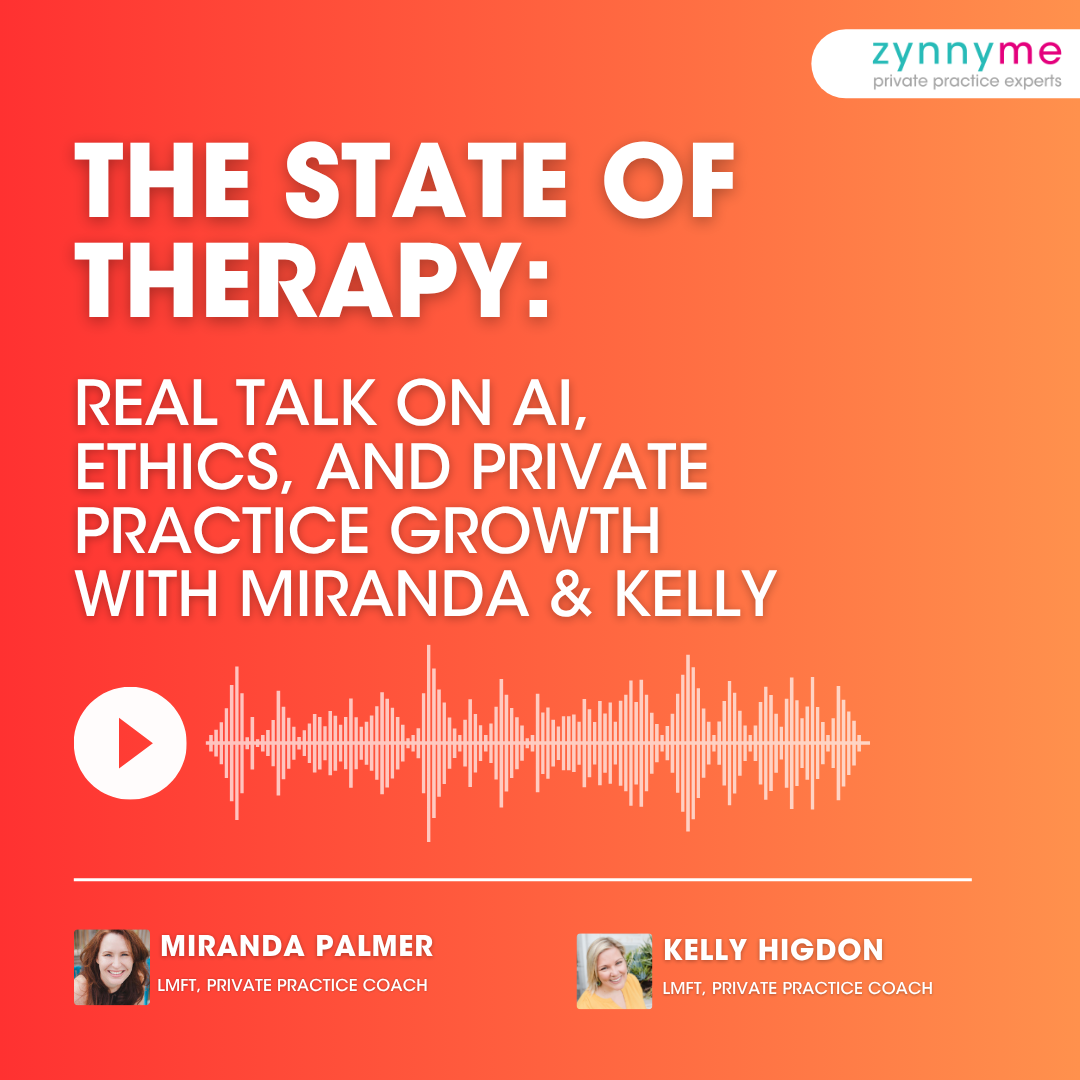
The State of Therapy: Real Talk on AI, Ethics, and Private Practice Growth with Miranda & Kelly
So, you’re wondering how to grow a thriving private practice in the brave new world of therapy post-2024. Maybe you sometimes daydream about a simpler time, off-the-grid, no wifi, paperwork done by magical woodland creatures. Or, more likely, you’re somewhere between “how do I get more referrals?” and “is AI about to take all our jobs (or just finish my notes for me)?”
You’re not alone. On the latest episode, Kelly and Miranda tackle the biggest hot topic in the field: Artificial Intelligence (AI). This isn’t your typical starry-eyed tech-lovefest or fear-mongering meltdown. Instead, it’s a playful, honest, real-world look at what AI means for private practice, why your uniqueness still matters, and how you can ethically and cleverly use new tools to grow your practice.
Ready for an advice-packed, heart-centered ride? Don’t worry, this blog won’t ask you to turn off your devices and move to an orchard (though you might be tempted by Miranda’s childhood stories). Let’s jump in!
Lesson 1: AI Is Already Here. So, What Are We Actually Scared Of?
Before you glaze over at the mention of robots, consider: therapists really are getting referrals from ChatGPT. As Miranda shares, “One of our clients said, hey, I’m getting more and more clients. Like, I got three clients this week that said ChatGPT referred our practice to a client. That’s how they found out about us.”
Wait what?! It’s true. Prospective clients stumped by the emotional labor of wading through endless Psychology Today pages are letting AI “scour those websites” and just give them the top 3 options that fit their needs. If you’ve ever felt invisible in a sea of therapist listings, this shift is huge.
But here’s the real talk: AI brings both “the problems, the opportunities, the realities,” as Miranda puts it. There’s the environmental cost, the possible loss of human jobs, and the headache of keeping up with rapidly advancing tech.
Kelly gets honest about how overwhelming it can feel: “For me, Miranda, I can get in the weeds and feel almost paralyzed sometimes when I’m trying to not cause harm.”
Takeaway: It’s messy, imperfect, and, yeah, scary sometimes. But ignoring it won’t make it go away, and there’s opportunity in facing forward, even if only one small step at a time.
Lesson 2: No, AI Won’t Steal Your Magic (If You’re Doing Deep Work)
Here’s a truth-bomb for any therapist feeling a little twitchy that ChatGPT is handing out therapy referrals like candy: If a machine can do what you do, it’s time to level up.
Miranda says it best: “If ChatGPT is replacing what you do in the therapy room, it’s time to level up, y’all... If what you’ve been taught is to give a regimented abcd, here’s what you do: fill out this worksheet and then come back and report to me: yeah, ChatGPT can do that.”
But: “AI will not replace attunement. AI will not replace somatics.” Kelly chimes in, “That thing cannot... be attuned to the physicality and all of the nuance of relationship building in this way.”
Takeaway: The real therapy stuff, the intuition, the subtle relational cues, the way you hold space, cannot be outsourced or automated. Instead of fearing AI, focus on what makes your work irreplaceably you. AI can help people find you, but it can’t be you.
Tip: Make your uniqueness as a therapist super clear in your marketing. “Can we communicate that on our website?” Miranda suggests. “How do we really communicate the, like, what we do, how we work? How do you claim your brilliance and make it findable to a client who’s searching?”
Lesson 3: Practical AI? Referrals, Marketing, and Documentation
Okay, so where can AI fit in, without replacing your expertise? This is where Miranda and Kelly’s enthusiasm shines. First, AI is helping clients find you, especially if your marketing is clear, niche, and genuinely you. “ChatGPT is searching sort of more like how a human would search... based on the specificity of the niches,” Miranda notes.
Second, there’s marketing, specifically, the agony of writing your website copy (yes, even if you’re a brilliant empathic communicator, sometimes selling yourself online stinks). Here’s where AI can help, not by replacing you, but by supporting you.
Miranda shares their process: “Now we have a custom GPT as part of the business school where it’s still someone really diving into filling out this worksheet, but now they can fill out the worksheet and put it into ChatGPT and get a really great rough draft, if not a final draft, like right out of the gate.”
Does that mean you just copy-paste whatever AI spits out? Nope. “The clinician is able to say, this doesn’t feel right. Hey, that’s not aligned. You still have to have the knowledge as the clinician as to what makes a good marketing message,” Kelly emphasizes.
And finally, documentation. Love it or hate it (mostly hate it?), AI tools are making SOAP notes and treatment plans less of a time suck. Miranda clarifies, “One of the ones that I really like that’s out there is it specifically does the documentation notes and the treatment plans just based on what you say about the session as opposed to recording the entire session.”
Takeaway: AI shines as a force multiplier for therapists, not by replacing your intuition, but by freeing up bandwidth, so you can focus on what matters most: healing, connecting, growing.
Tip: Use AI to break through inertia (hello, blank page), but never turn off your clinical brain. Tweak, personalize, and make sure your authentic voice comes through.
Lesson 4: Proceed with Caution! Ethics, Privacy, and Owning Your Data
Here’s where the ‘AI can do everything!’ crowd needs to slow their roll. We need to discuss the ethical and privacy issues that come with new tech. AI chatbots for client support? Not so fast.
Miranda issues a solid boundary: “I definitely 100% say no AI for... chatbots, for your practice, y’all. Like, this is, we’re not there yet. I don’t know if we will be there. I don’t know how I feel about that. But that’s like, a hard path.”
And as Kelly points out, bias in AI is real: “If we’re in a racist system, AI is built on that system.” AI diagnoses and interventions can reflect the same blind spots and inequities baked into the data.
There’s also data security. Don’t sleepwalk through tech contracts. “Now I will put that into ChatGPT and say, Is there anything I should be concerned about in these terms of service?” Miranda says. “So often I’ve done that when I’ve already read through it. And I have a sense that I feel like something is far-reaching. But it’s kind of fun to almost get, like, you’re getting a second opinion.”
Takeaway: AI can be a powerful tool, but only if you pilot it with a clear sense of ethics and eyes wide open. Use your therapist superpowers: boundary-setting, discernment, and a healthy dose of skepticism.
Tip: Whenever you use AI for client-facing work (or documentation!), check the privacy policy, terms of service, and how your clients' (and your own) data will be stored and used. Bring your critical thinking every time.
Lesson 5: Implement Mindset Shifts - Imperfection, Ownership, and Balance
Learning new skills and integrating new tools, especially in the face of anxiety and not-knowing, takes courage. Kelly affirms, “I feel way more balanced about it than I did originally. I think sometimes there’s anxiety or trepidation around things I don’t know or don’t understand. And I also proceed with caution and my own intuition and knowing. And I hold my ethics, and I really look at where is the power?”
Here’s the zynnyme secret: Your private practice will always live in the tension between innovation and intuition, imperfection and impact.
Miranda captures it: “I think there’s... I think it’s really easy sometimes for us to be all or nothing regarding new technology... We’re in the midst of this shift and this change. So can we find the things that really work for us within it that help support us... so that we can do what we do best, which is heal people, help people heal themselves, help people reconnect.”
Takeaway: Give yourself permission to be imperfect as you learn. You can use AI without handing over your expertise or power. You can embrace new tools and fiercely protect your ethics and voice.
Practical Actions for Therapists in Private Practice
Claim Your Marketing Voice: Get specific and personal about what makes your work special. Use AI as a draft tool, not a ghostwriter.
Leverage AI for Referrals: Make your online presence visible and authentic. AI is pulling up therapists who are clear about niche, approach, and outcomes.
Consider AI-Powered Docs: New tools can ease your paperwork burden. But choose ones that align with privacy laws, don’t record sessions, and keep your data safe.
Don’t Hand Over the Keys: Let AI support, not supplant, your clinical wisdom. Edit, revise, and own your messaging and notes.
Read the Fine Print: Treat every new software contract as if it could land you on the front page of Therapy News, and protect your data and your clients.
Take the Next Step: Choose Growth, Not Overwhelm
Miranda and Kelly’s message is simple but passionate: “If you want some support in creating a private practice that really works for you, that is really client-centered and that uses AI in just the ways that make sense for you and your clients, check out our business school for therapists. We dive in and give you opportunities and options about how to use AI ethically throughout your practice and what the alternatives are if you don’t want to use it at all.”
So, therapist-founder, entrepreneur, and all-around helper: You are the magic ingredient in this fast-changing landscape. Use the tools that serve you, leave what doesn’t, and surround yourself with guides, community, and encouragement.
Want a step-by-step roadmap to building a meaningful, sustainable, and even joyful private practice? Explore Business School for Therapists because you don’t have to stay stuck in the weeds, and you absolutely don’t have to brave the new AI wilds alone.
Here’s to you and the beautiful, bumpy, absolutely human adventure of building a private practice that works.
Resources Discussed
Let’s keep changing the world, one ethical, client-centered, slightly AI-assisted session at a time. Until next time!