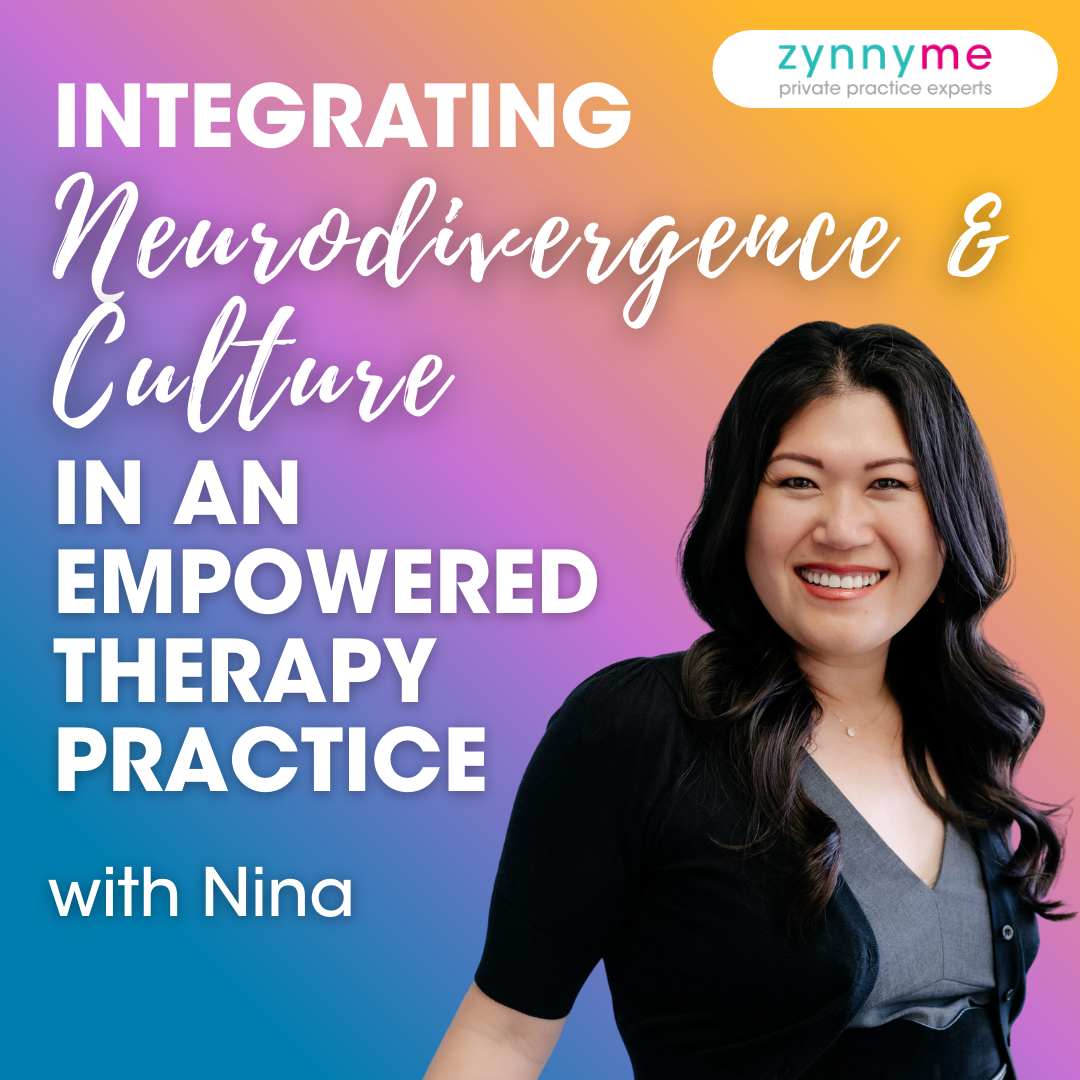
Integrating Neurodivergence & Culture in an Empowered Therapy Practice with Nina
So, you want to start (or fortify) your own private therapy practice. Maybe you’re fantasizing about making your own hours, saying goodbye to 43-minute lunch breaks, or finally offering services in the way your brain and heart have always dreamed. Maybe, like so many of us, you have an itch to do it differently. To help clients who don’t quite ‘fit’, while also trying to heal yourself along the way.
Wherever you are on the map, today’s episode of Starting a Counseling Practice Success Stories is a must-listen (or! must-read recap right here). Our brilliant guest, Nina, joined Kelly for a deep dive into the healing journey of building a private practice while rediscovering herself as a neurodivergent, first-generation Vietnamese immigrant. Nina shares the tough stuff (hello, family disapproval and identity crisis!) alongside real-deal takeaways and encouragement for other therapists on this path.
Grab your notepad, brew your favorite beverage, and let’s jump into the wisdom Nina brings!
Dreaming in Private Practice: Why Go Solo?
Let’s start at the beginning: Why private practice, anyway? For Nina, it all began with an 11-year-old vision (inspired by a book, as all good therapist stories are). But it was more than childhood fantasy that took root: “That was my vision back then… [and] the private practice [was] appealing to me because of the freedom aspect of it. I'm my own boss, and I can do whatever I want with my degree.”
Insert every therapist’s secret thrill: the intoxicating idea of autonomy. But, as Nina gently reminds us, “I definitely didn’t do it for the money. I didn’t know that we didn’t make money in private practice.” (Cue knowing laughter.)
Takeaway: The freedom to shape your work (and work-life!) is a major pull. Don’t underestimate the value of pursuing a model that fits the way you want to care for yourself and others.
Tip: Ask yourself, if no one were watching or judging, how would you want to work? Let the answer steer your practice’s direction, not just outside expectations.
The Loneliness Factor: Busting the Myth of the ‘Perfect’ Practice
But here's the real talk: The path can be lonely. Not only did Nina’s Vietnamese immigrant family not support her career choice (“my family was and still is against me being [in] this profession”), she also didn’t have cultural role models in private practice. “It was quite lonely,” Nina admits. “I winged it. I didn’t know what I didn’t know.”
Sound familiar? This isn’t just Nina’s story. For so many therapists, especially those from marginalized or first-generation backgrounds, the journey into private practice can feel like solo backpacking in uncharted mountains.
What changed the game? Community. Nina credits zynnyme as the place she first “started to connect with other people, therapists, [and] the community.”
Takeaway: Isolation breeds doubt and confusion. Community and mentorship aren’t nice to haves; they’re the difference between feeling lost and finding your tribe.
Tip: Seek out community, business schools, supervision groups, or even an online therapist forum where you can say, ‘Does anyone else feel like they don’t fit?’ Spoiler: The answer is yes.
Neurodivergence as a Game-Changer: Rewriting the Story
Here’s where things get super inspiring. Nina’s latest evolution? Embracing her own neurodivergence, discovered through her journey of parenting a neurodivergent son. When her son was identified with dyslexia, ADHD, and giftedness, Nina did what therapists do best: She dove into research. “All of these things are highly hereditary. So then, like, okay… where do you get it from? So… that led to me, to me realizing that I have ADHD, and you know, very likely I’m gifted also.”
But the revelation was more than a diagnostic label. Nina describes it as “finally living life with corrective glasses.” Suddenly, what felt vaguely off for decades clicked into sharp focus.
In Nina’s words: “It wasn’t until this neurodivergent piece that it felt like I was finally living life with corrective glasses… [Now,] I have such self-awareness now and so much more confidence, and I feel like there’s tremendous healing, self-acceptance, and that feels so good.”
Takeaway: Reckoning with your own wiring, whether it’s cultural, neurological, or both, transforms not just your self-esteem, but your whole approach to work, and who you serve.
Tip: If something about traditional practice (or even your own history) ‘just doesn’t fit’, be curious instead of critical. New self-understanding can unlock compassion and confidence in yourself and your clinical work.
Healing the ‘Not Belonging’: When Clinical Work Mirrors Personal Work
For Nina, the ‘not belonging’ wasn’t simply about neurodivergence. It was compounded by being a first-generation Vietnamese immigrant, a survivor of intergenerational trauma, and living in a family and culture that pathologized difference. “I grew up being told all the time that…I was lazy, stupid, because, you know, I’d forget things or I’d ask lots of questions. And I was too much. I was too much of everything.”
That ache for belonging, that quest to understand ‘what’s wrong with me?’ traces directly into her clinical focus. As Kelly notes: “It’s really common for us to build practices on our own healing process and our own journey and experience.”
Nina agrees: “I think what we do is so unique that it’s hard to separate…who we are as a person in our own journey from our practice.”
Takeaway: It’s normal and powerful for your practice to mirror your own process of self-discovery, grief, and healing. The themes you’re called toward (identity! belonging! feeling ‘other’!) aren’t selfish; they’re evidence that you walk the talk.
Tip: Let your practice be a place where you “work with people who felt different,” as Nina says. The clients who most need what you’ve lived will find you. And surprise! They’ll heal with you.
The Mindset Shift: From Isolation to Acceptance and Advocacy
Perhaps the biggest shift for Nina came with not just accepting her difference, but turning it into her superpower. “Bottom line: I’m a better therapist,” she declares. “I hear, I listen differently, I conceptualize differently… I’m able to educate, I’m able to help people understand not just themselves, [but] the people in their lives too.”
Through the lens of neurodivergence and trauma, Nina stopped pathologizing difference, including in herself, and became curious instead. “It’s just really increasing understanding for themselves and then how the people in their lives are. And to work with that as opposed to like, well, they’re bad or they’re whatever it is.”
This shift isn’t just clinical. It’s business magic: Nina now advocates, educates, and even speaks at conferences about neurodivergence in the Asian and Vietnamese community, breaking cycles of shame and secrecy.
In her words: “Breaking the cycle of trauma, abuse is my longstanding passion… but now I just feel more clear as to why this is so important to me.”
Takeaway: Your vulnerabilities as a therapist, parent, or human are not liabilities. They are the roots of your strongest, most resonant clinical work and practice vision.
Tip: Practice curiosity about your own story, not judgment. Not only does this shift your self-concept, but it empowers you to market, speak, and serve in ways that only you can.
Redefining Success and Handling Doubters (Even When They’re Family)
If you think stepping into your purpose guarantees applause, think again. Nina’s family still doesn’t approve of her being a psychologist. “A lot of guilt, too. Like, you know, we didn’t risk our lives to come over here for you to do this…And then a lot of shame, you know, other kids your age…they’re doctors and why can’t you be like them?”
Oof, we know this sting. Nina meets it with grace: “I took those, their intentions and made something my own… I feel like I’m doing so, so much goodness in the world… This is what it looks like for me. And I am happy and I feel fulfilled and my life has a lot of meaning.”
Takeaway: Fulfillment can’t be measured by anyone else’s rubric. Not your parents, not your supervisors, not even what you planned in grad school. Your version of success counts.
Tip: If you’re getting pushback (even from loved ones), check in: Am I following my truth, or borrowing someone else’s? Then put your stake in the ground.
Trauma, Advocacy, and Vision: Where Nina’s Practice Is Growing
Drawing on her new lens, Nina’s practice is blooming in ways she never anticipated. She’s laser-focused on serving Asian clients and anyone from generations or cultures where neurodivergence is not recognized. She brings trauma-informed care, advocacy, and psychoeducation into her practice and her public speaking.
“Knowing this can really help heal intergenerational trauma…because, you know, if you’re like this, I mean, your parents are… You probably, you got it from somewhere too. They’re probably like this, too. They didn’t know that either.”
Nina isn’t just building a profitable business, she’s living her mission, expanding her impact, and finding a bigger, more supportive world “than just me and my anxiety and self-doubt.”
Takeaway: The more self-knowledge and acceptance you cultivate, the wider your impact, and the clearer your messaging as you grow and market your practice.
Tip: Let your practice vision evolve with each personal aha moment. Don’t box yourself in; allow yourself to experiment, speak, and even be seen in new ways!
Nina’s Advice for Therapists on the Path
Now, drumroll: If you’re reading this as a therapist starting or lost in the private practice journey, Nina’s advice is a mic-drop:
“We are the tool of our trade. So really invest in yourself. Really do the hard work of, of looking at yourself… Even before all of this. Right. I'm a strong believer in our own therapy, our own journey of discovery.”
And, most delightfully, “It’s okay to like something even if it’s, you know… not very popular or it’s just look at yourself without censoring and editing.”
Takeaway: There is no right way to practice, only your way, informed by self-reflection and ongoing self-acceptance.
Tip: Double down on your own healing. See your quirks, pain points, neuro-spiciness, and cultural collisions as clues. Be fearless in uncovering and championing who you are.
Resources Discussed:
Tell Us:
What lesson from this episode will you carry forward? Drop a comment, share with a friend, or just take that first brave step!