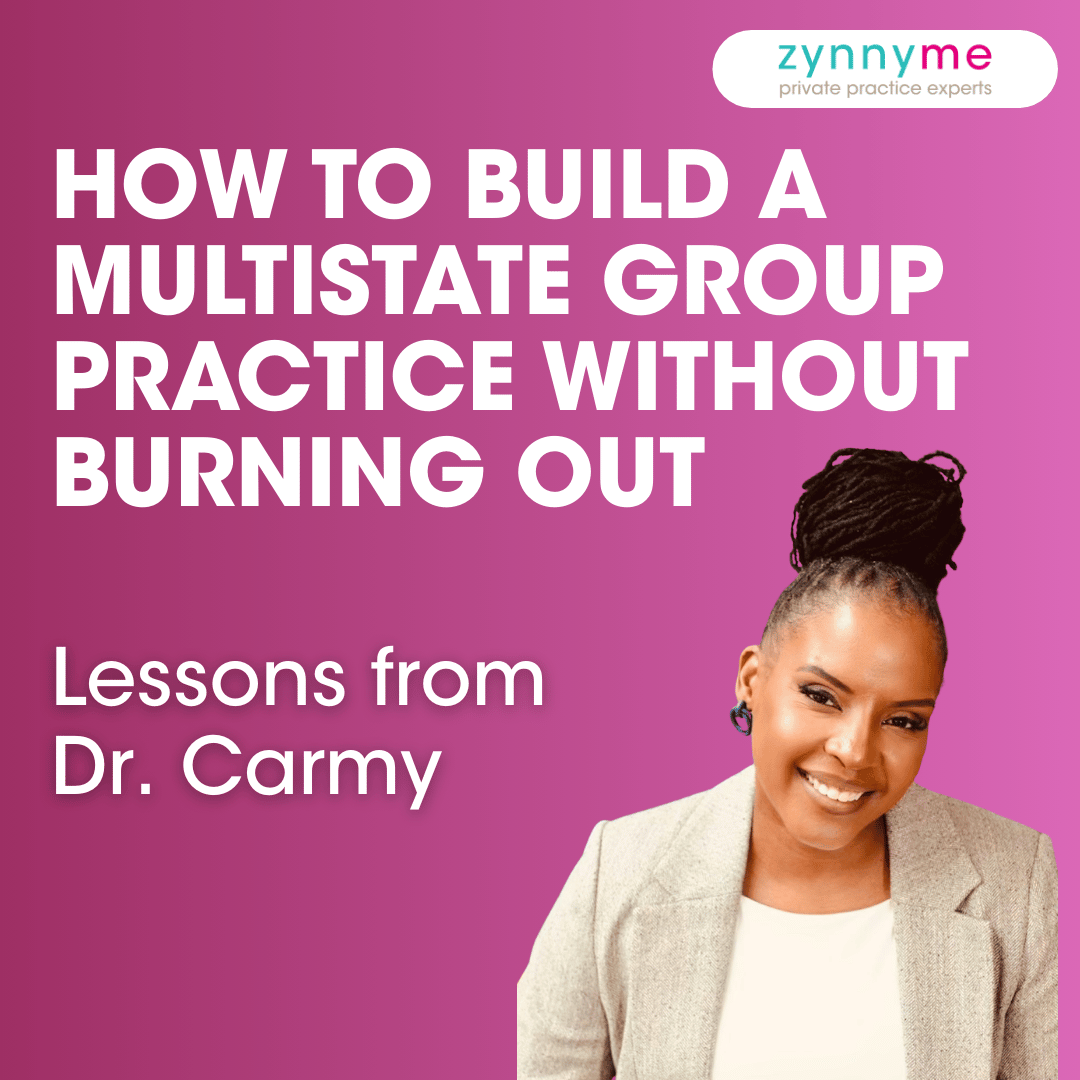
How to Build a Multistate Group Practice Without Burning Out: Lessons from Dr. Carmy
So, you're thinking about starting or scaling your own counseling practice. Maybe you're knee-deep in the "should I do this?" Google rabbit holes. Maybe you keep imagining yourself with your laptop, mug of something warm, and just the right amount of sunlight cascading onto your desk your space, your rules, your clients, your big therapeutic heart… until you get hit with the "Wait, am I even allowed to want money for this?" panic spiral.
Breathe, friend. Pour a cup, get comfy, and let's get real because you're absolutely not alone.
Meet Dr. Carmy, a therapist, entrepreneur, and champion of healing the healers. Her journey from teenager-advisor to founder of Destined Horizons, a multistate group mental health practice, is packed with winding detours, raw honesty, and the mindset shifts that turn overwhelm into ownership. Her story is your playbook for building a counseling practice that's as sustainable as it is impactful.
Ready for lessons, laughs, and maybe permission to take yourself seriously? Let's go.
Your Path to Private Practice Doesn't Have to Be a Straight Line
Dr. Carmy was the teenager all her friends came to with their problems, asking for advice and help sorting through their issues. Sound familiar? She started college as a nursing major. Family pressure was real, but she quickly discovered her calling when a psych class felt like home.
But here's the kicker: knowing your calling and actually building a practice around it isn't a straight shot. Dr. Carmy went from psychology undergrad to business school to working as a juvenile detention program director, only to finally make the leap to solo practice a full decade after she graduated.
Takeaway: If your road to practice ownership feels circuitous, congratulations, you're normal. Detours aren't dead ends. Often, they're reroutes toward exactly where you need to be.
Therapist Pay: You're Allowed to Want More
Let's be real: Dr. Carmy's first position paid $30,000 a year while her accountant sister started at $60,000. Therapists everywhere just let out a collective groan. She was passionate about the work, but the reimbursement wasn't supporting her family.
She leveraged her MBA, climbed the ranks, but ultimately, the numbers didn't add up to fulfillment. That classic tug-of-war between passion and paycheck? It's not just you. At some point, you'll have to balance what you're doing outside of that therapy room, too, because how you manage the business side directly affects how you show up for your clients.
Takeaway: You don't have to choose between heart and smart. A sustainable practice, one that pays your bills and feeds your soul, makes you a better therapist. Want money talk permission? You have it.
Recognizing Therapist Burnout Before It Takes You Down
Dr. Carmy's first years in solo practice were rough. As a single mom who'd made a bold move to Georgia with two kids, she was pulling 10- and 12-hour days. Life-work balance was a joke. It was survival mode, but she felt good about the work, so she kept pushing.
Until she couldn't.
The compassion fatigue hit hard in 2017 and 2018. She wasn't showing up the same way, and she knew it. She was crying at the end of the night. Something had to give.
Burnout is not just an individual failing; it's a systemic setup, especially in mental health. Dr. Carmy started pulling back, referring out instead of shouldering it all, and reallocating her energy toward what actually moved the needle.
Tip: Notice where your boundaries are blurring. If you're constantly drained, it's time to adjust, not just push through.
Why Every Therapist Needs Business Systems (Even With an MBA)
You'd think having an MBA would make private practice ownership a breeze, right? Not exactly. Dr. Carmy found it incredibly hard to separate the passion for the work from the business side. When you're driven by the mission, you take on every client who calls because you can't say no to an intake without ever calculating how much revenue you actually need to stay afloat for the month.
Systems changed everything. Learning to track her numbers, put referral systems in place, and yes… say no saved her from drowning.
Takeaway: You're not failing if you find the business side hard. Therapists aren't taught how to run a practice, but you can absolutely learn enough to thrive.
What Nobody Tells You About Starting a Group Practice
Are you imagining group practice as "me times five, plus more revenue"? Dr. Carmy's experience might pump the brakes on that fantasy.
The initial assumption was that more clinicians equals more money coming in. But you have to pay them. There are more expenses as you take on more clinicians. That was a significant oversight and she's not alone in making it.
Then there's the insurance panel math. Dr. Carmy was on every panel, and while some paid close to her rate, others paid a third of it. She never revisited those contracts until she learned a critical lesson: you don't have to be on every insurance panel. Being strategic about which panels you accept and dropping the ones that undervalue your services isn't just okay, it's necessary as your group practice grows.
Tip: Group practice means balancing oversight and autonomy, training clinicians up, and keeping your systems tight. You don't need to say yes to every contract just because clients are calling.
How to Delegate as a Group Practice Owner Without Losing Control
Here's a big one: control. Dr. Carmy candidly admits she spent her early days as a group practice owner hovering over notes and micromanaging. Then she had the realization she'd taken on this new model, so she could breathe a little bit. She had to let go.
But letting go doesn't mean disappearing. There's a sweet spot between micromanagement and hands-off leadership. One clinician might need more oversight with documentation, while another needs support with time management. It was never the same formula for each new team member.
Takeaway: Leadership is custom, not cookie-cutter. Trust your team, but build systems and checks with clarity and care.
Why Therapist Community Changes Everything
What turned the tide for Dr. Carmy? Community. Finding other practice owners who understood the struggles made her realize she wasn't the only one experiencing them and that alone was transformative.
Therapist isolation is real, especially if you're virtual, working across states, and juggling a team from behind a screen. Dr. Carmy's pivot was getting out of the "I'll just fix it myself" rut and joining a business school and community of like-minded practice owners.
Tip: Sometimes the single most powerful thing you can do is get in rooms, virtual or otherwise, with other practice owners who get it.
Growing a Practice Also Means Growing Yourself
With systems in place and burnout at bay, Dr. Carmy started giving back, offering clinical supervision, mentoring therapists, and speaking up about mental health, especially in marginalized communities. Her "Normalize Mental Health" hat is a symbol of everything she's about: breaking the stigma, particularly in Black and brown communities where mental health has historically been off the table.
Her mission has expanded to focus on helping professionals themselves. How are they caring for themselves? How are they dealing with their own traumas so they can show up fully in the therapy room without being re-traumatized and not even recognizing it?
Takeaway: Your healing matters. Your boundaries matter. Your visibility matters especially for clients and clinicians who need to see themselves reflected in this field.
The Mission Behind It All
What's at the heart of Dr. Carmy's practice and mission? Bringing clarity to dark places, which is what therapists do every day.
And her message for the profession right now is urgent: we need to save our profession. We need to heal every therapist we have, not just work on getting new people trained. We need to really take care of one another as part of a community.
If you take nothing else away, absorb this: You don't have to do this alone. You're allowed to want more. You're allowed to get support. And you're needed — just as you are, but with all the permission slips you've been waiting to write yourself.
Key Takeaways for Therapists Starting or Growing a Private Practice
Expect a winding journey, not a straight line. Your detours are building skills you'll need later.
Redefine success again and again. What worked in year one won't serve you in year five.
Honor burnout. Let it lead you to change, not just guilt.
Invest in business systems even if you consider yourself naturally business-savvy.
Be strategic about insurance panels. Client volume doesn't automatically equal sustainability.
Lead with balance. Let go of micromanaging, but don't disappear from leadership.
Find and invest in community. Isolation is the silent practice killer.
Grow your business, but don't forget to grow yourself. Your well-being is the foundation everything else is built on.
Ready to Build a Sustainable Counseling Practice?
Wherever you are, newbie or veteran, solo or scaling, wide-eyed dreamer or burnt-to-a-crisp survivor, everything you're feeling is valid, and support is available.
Take the next right step. Connect with your community. Revisit your boundaries. Drop an underpaying contract. Hire strategically. Say yes to a mastermind. Rest. And step into the therapist-CEO your practice and your future clients deserve.
Looking for a community of practice owners who get it? Learn more about Business School for Therapists →
Here's to clarity, courage, and plenty of coffee on your practice-building journey. ☕
Normalize mental health. Normalize community. Normalize you.
Tell Us:
What lesson from this episode will you carry forward? Drop a comment, share with a friend, or just take that first brave step!