Kelly Higdon [00:00:00]:
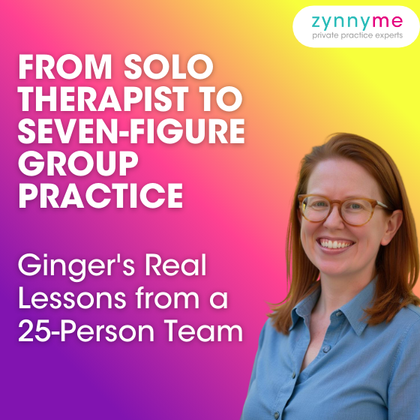
Welcome back to the podcast. Today is going to be a good one for all of you who are wondering about group practice, having a ton of employees. How do you get there, and how do you get past the 6-figure mark and into the 7-figure mark? And is that even possible in private practice? Because today I'm joined with Ginger Houghton, a licensed clinical social worker in Michigan who has a group practice, works with horses, does all sorts of cool stuff. And I've known Ginger before Ginger had a practice, really. And I think it's important to have this conversation because a lot of people think that once you just know how to get started, that's enough. Um, but there's a lot of learning in this process. And so Ginger, thanks for being here to share your story and the lessons you've learned along the way. I'm so glad you're here.
Ginger Houghton [00:00:59]:
Thanks so much. It's so amazing. Thanks for the invite. And it's, uh, I would not be in the place that I'm in with my practice if it was not for you and Miranda and all of your team and all of the support and all the resources, because it really is really amazing to build a practice that fits your values, but you— it's a never-ending kind of learning.
Kelly Higdon [00:01:21]:
Yeah. For everyone listening, can you paint a picture of what your practice looks like today? Like the size, like what you all do?
Ginger Houghton [00:01:31]:
Yeah, there are 25 of us now, um, and 2 office staff. We have the most magical staff you could imagine. Talented providers, kind providers, everyone goes above and beyond, and just really a supportive place to work. Most of our staff works remotely, I would say, and then we have a small in-person space, and then we also work out of a satellite location where we do equine-assisted therapy, um, partnering with a nonprofit. So my practice today looks infinitely different than it did when I started, uh, right when I first met you.
Kelly Higdon [00:02:12]:
When you first started, did you think you were going to be a group practice owner with all these staff?
Ginger Houghton [00:02:17]:
No, I had no idea. I had no intention either. I just wanted to get out of a toxic nonprofit work environment. I was a little bit done screaming into pillows when I was trying to just give basic resources for clients or clinicians. So I just said, I want to go and do good clinical work. I'll be in an office by myself. I will be lonely, but I will figure it out. And that's kind of where I started.
Ginger Houghton [00:02:42]:
But within a, a month, people who I had worked with in the past at other organizations, or I had supervised, reached out and said, you're already in solo, why are you not doing a group? Can I join you? So it was not the intention to start a group, it just kind of happened through relationships, which is like an important note if you want to go in and build a group, is relationships really, really, really matter.
Kelly Higdon [00:03:07]:
What's the timeline from starting your practice to where you are now? How many years have you been doing it?
Ginger Houghton [00:03:13]:
Yeah, so I started my practice when I had a baby, baby. So, um, and that, like, 2018 is really when I said, okay, I'm done. I can't live this nonprofit existence, as much as I love nonprofits and serve them in other ways now. Um, but I, I knew I couldn't do it anymore. So I started in August of that year on a vacation with my family, uh, getting a logo and filling out paperwork and doing all the things. Mm-hmm. Um, yeah. And here, here we are.
Kelly Higdon [00:03:47]:
About 7, 8 years.
Ginger Houghton [00:03:48]:
Yeah.
Kelly Higdon [00:03:49]:
Yeah. Oh, before we started recording, I kind of joked about you being a clinical social worker and what business do you have having a big practice like this? Did, did you encounter any of that like internally as a social worker? Because I do hear that often of like, oh, this goes against our ethics to be so profitable. It's, it's, we, clinical social workers tend to be raised up in nonprofit culture more so than other license types. I'm not, I'm not, I don't want to, you know, no, it's, it's not a bad thing.
Ginger Houghton [00:04:25]:
And like, not, there are so many beautiful things about nonprofit, the nonprofit world. There are also some really hard things to plan your entire existence on a nonprofit salary. It's not always possible, and sometimes the environments aren't healthy. I did not plan to be a business owner ever. That was not on my radar. I did not feel equipped. I'll be very honest. I almost quit, um, in my first office because I was so frustrated by calling the insurance companies and trying to decode what I needed to decode to get to the next level that I was like, if I can't make these phone calls, I can't keep moving forward.
Ginger Houghton [00:05:04]:
I can't keep moving forward. I need to move into the nonprofits, which is not moving backwards, it's just a very different choice. And I knew for me, having kids— and I have a complicated kiddo with an autoimmune disorder, I, I have all the, all— I have all the health stuff— I knew that I could not work 40 to 60 hours a week on someone else's terms anymore.
Kelly Higdon [00:05:25]:
Yeah.
Ginger Houghton [00:05:25]:
So I had to get over my own, like, social worker, I should do this because of everybody else's needs. Um, our work has to meet our needs and every— and our clients' needs. It's not mutually exclusive.
Kelly Higdon [00:05:39]:
I want to talk about, since this is all focused on starting a practice, I want to talk about the difference in starting a solo practice versus starting a group practice and kind of like what is needed. So when you started your private practice, what were some of the biggest like struggles or learning curves for you?
Ginger Houghton [00:05:59]:
I had decided that I was going to do an insurance-based practice. I'll be quite honest, if I— if it was me today, I would follow you and Miranda's advice and do a private pay practice, um, if I was doing that today. When I first started, I think the biggest learning curve was for sure insurance. I knew quite a bit going in, but it took me longer than I thought to get credentialed. But it's very possible, and you need to know that if you're going to go into private practice, you need to know how to do your own credentialing. Because people can tell you things and it's not that hard. You just have to be persistent and wake up and keep doing it. It's the same thing for billing.
Ginger Houghton [00:06:38]:
You just have to wake up and keep doing it. And if you can't get an answer one place, you go another place, right? I think those two things were really hard, the credentialing and then the billing and getting kind of a system down. I think outside of that, the marketing is a huge thing. Figuring out what your niche is going to be, who your ideal client is, what trainings you need to get really amazing outcomes. After that, if you want to go into a group, you have to make sure all of your stuff is really tight before you start bringing people on board because you don't want to have like a super leaky boat that you're having people hop onto with you. So making sure that however intakes are coming in, it's a clean, smooth process for clients and clinicians. Making sure that your compliance stuff is up to date. So like knowing that when Aetna or Blue Cross sends a bulletin, it is worth the 2 minutes to scan through and just search for behavioral health to see if there are changes that impact you.
Ginger Houghton [00:07:39]:
Knowing that those small things at the beginning help you build a tighter ship so you're not constantly going back to people and saying, we need to do this differently. You will have to go back and ask people to do stuff differently. That's just the world that we live in, and insurance companies can ask us what they would like. But those compliance things early on, HIPAA, insurance billing, coding, making sure that the compliance stuff is really good early on, I think was really, really helpful in helping us get to where we are now.
Kelly Higdon [00:08:10]:
Okay, I'm gonna ask you a question that you're, I didn't prepare you for any of these questions. This is just an honest conversation of when you started your practice, there were not venture capitalist platforms out there per se really doing the credentialing and the billing that's what they say they're there for, but they might be there for other things. And so now when someone may hear you say, oh, this is a learning curve, and they're like, I'll just outsource that to a venture capitalist platform, um, how do you feel about that? What are your thoughts about using tools like that? Would you use them today? So this—
Ginger Houghton [00:08:49]:
I think I have really strong feelings on this. Um, I, and I will self-disclose, I worked for a VC for like 35 days. Um, so they existed. It was just very, very short term. I was like, this is not for me because there were ethical issues that I saw right away that I was like, I cannot see clients outside of my own state. That's not what my license is. That, and there's no one to talk to about that. There's nothing to do.
Ginger Houghton [00:09:15]:
Um, honestly, I think if someone is really serious about building a private practice, The only way to do it sustainably long-term is to figure it out, to go through the learning curves. There are lots of folks that can help you with credentialing, but learning how to do it yourself, it's not that hard. Social workers are smart. LMFTs are smart. We're bright people that went to school. We can connect the dots. We went through years of graduate school. We can for sure get on Blue Cross's website and follow the steps and make a phone call.
Ginger Houghton [00:09:48]:
We don't like it necessarily, but if you don't know how the process works, you're always beholden to someone else, which is the major concern that I have right now for folks who are saying, well, it's easy for me to do this, it's, it's very fast for me to set up. I think the challenge is that it's like going to kill our market and kind of this industry, um, before we know it. We've seen it happen in other industries, it's just coming for us right now. And I think it's very easy to make the choice, and I also understand sometimes for survival reasons people have to make the choice to go with the VCs. They don't have, um, the luxury, yeah, of being able to, to stick it out. If you're gonna do that, I just think it's so important to do lots and lots of research about how hard it is to get off of the VC platforms when you're done with it, when they have messed with your clients and they have messed with you, and they— to get your credentialing back for you is, um, it sounds like incredibly difficult, and you still have to go through the learning curve. Bite the bullet, eat the frog, whatever, in the mouth of the wolf, whatever you're saying is right. I would really say if you're serious about it to start and learn and figure it out.
Ginger Houghton [00:11:05]:
It's worth staying where you're at for 2 months longer, get your credentialing set, do it on the weekends. You can do it. That's what I would say.
Kelly Higdon [00:11:12]:
Like, being on insurance— I know everyone thinks that we're just all about cash pay, but we're not. We're about like doing insurance in a way if it works for you. I want to know, at a solo practice level, how did you feel about the profitability of being on an insurance panel with how much you had to work to get that profit?
Ginger Houghton [00:11:33]:
Um, I am extremely resourceful, like to a degree that it's like concerning sometimes. What I'll say is, it is— you can be profitable. You're not going to be making $3 million in solo on insurance. Like, that's not reality, right? Um, you can make the numbers work. I just think people have to be willing and open to say, like, I'm not probably gonna have the nicest, brand newest office with all of the best furniture and all of the you might not be like living the luxury life, but you can find a way to be resourceful and make those numbers work and find a nice space and find amazing clients and do really good insurance-based work. I just think it's about like being very intentional about the choices that you make along the way and not being afraid of your numbers, because most therapists have math anxiety and are very avoidant, and you just kind of can't be if you're going to be in private practice long term.
Kelly Higdon [00:12:36]:
Yeah, and you mentioned about marketing. Can we talk about marketing your solo practice first in terms of where did you land in terms of your niche, in terms of what's going to get the best clinical outcome, and how that impacted your marketing?
Ginger Houghton [00:12:50]:
So when I started originally, like, I had very limited experience with marketing. Almost everything I knew, I knew from Zinni Me, from business school camp, which was really incredibly helpful, and like identifying like an avatar and ideal client and going through that, finding keywords. For me, originally I was doing substance use work because that's one of— I have a CAADC, and I was doing chronic pain work and sleep work, which was great. Um, I love, I love all of those things. It turned out as we morphed into a group, I was the only one that cared about those things. It's not that people didn't care, people didn't want to niche down in those ways. Which ended up shifting us more in the direction of things that I also had an interest, which was EMDR and brain spotting and deep brain reorientation and equinuses did. Trauma work.
Ginger Houghton [00:13:52]:
So, what I've learned about marketing over time is like, what worked for me in solo was very effective for me in group as we grew. Because people knew me for one thing, um, and I really needed that marketing to be about what they knew about us as a group. And that's a different climb than it is in solo, right?
Kelly Higdon [00:14:12]:
I think what is the through line that you have found now for your group practice compared to your solo, right? You have this solo practice with this pain and sleep stuff and addiction, and then you find the golden thread for the group. What is that?
Ginger Houghton [00:14:26]:
It's really trauma-focused work for people who haven't benefited before from therapy that we really specialize in people who are like, I went to therapy, my therapist was nice, and I love talking to her, but I didn't really change, um, that from beginning to end. Like, we use the, um, Sage SR to like make sure that our diagnosis is really on point. We're using some different tools to say from go, we need to know more about you because you've already had an experience where probably the diagnosis was off, or the, the modalities that they were using were off, something was off, um. So really figuring out what to do really good trauma-focused work, knowing we needed better tools, knowing our therapists needed better training, and that we wanted to get known for that as opposed to something else.
Kelly Higdon [00:15:15]:
So let's think back to your first hire. You're starting your practice. Who are you, Ginger, as a leader then compared to who you are today with 25?
Ginger Houghton [00:15:25]:
Listen, you could call my first hire Rachel Friedland. She still works for us. She's amazing. She was also an intern for me, um, and a physician in a previous life. She's amazing. I think what she would tell you is that, like, I really had no idea, even though I had been leading in nonprofits. I had been leading within their, their guardrails for a really long time at different places, which was helpful. But I think she would say that I'm a very different leader today, even, even from 2 years ago.
Ginger Houghton [00:16:00]:
Because my confidence and the numbers and the math and the business piece is very different than it was starting out, where I was like, do whatever you want, see as many clients as you want, this is so great. Which, like, I still want to, to feel like that. It's that, you know, like, people need freedom and people need positivity, and we're also running a business. So those two things, if we're a teeter-totter, they have to balance out at the end of the day. That I did not get when I first hired her, or I would say probably my first 10 hires, I did not understand that very well.
Kelly Higdon [00:16:34]:
There's a lot of talk now about group practice and not even starting it, that people are losing their clinicians, that these platforms have kind of taken over and that sort of thing. What have you found has been helpful in building this group practice to honor your team in a way that allows for retention um, and still profitability for you and satisfaction for you without, you know, while everyone wins, kind of?
Ginger Houghton [00:17:04]:
Yeah, I think I invest— I really love to invest not just in training folks, right, but also I do genuinely care about them as people. I— we're making hires based on clinical skills, but we're also saying, is this person going to be like an amazing team member? Um, so I really try to— orientation, right? Orientation is an intervention in what we do, making sure that we are laying a really good framework from beginning to end for us to have a nice relationship. Because things come up, there are problems, there are things that go wrong no matter where you work. But trying to have people feel like I'm approachable, trying to have people know that I genuinely care about them and their family, and that I'm always making decisions as a steward for the business as opposed to me as a person. So I'm looking out for everyone's best interests. I do think people have that idea, and that's helped keep our staff really stable over time. There have also been other things that we've done. So we rolled out profit sharing.
Ginger Houghton [00:18:18]:
To say if you are killing it with your numbers, like, of course there should be more profit headed to you. I don't, I don't need more than what I, I need to make this worth my time and effort, right? And we have good admin staff and we have a really amazing clinical director. So profit sharing was really helpful. I think treating staff nicely and staff also knowing that Whenever possible, we really try to do red carpet exits, which is not something that most people in the nonprofit world experienced. So knowing that those conversations about exit start at the beginning, just like in clinical work, right? But, but I think most people haven't worked in an environment where like the goal is transparency. The goal is to say like, this really isn't a fit, and if it's really not a fit, like, let's help you transition to something else. I'm not a prison warden. I don't want to be.
Ginger Houghton [00:19:16]:
Um, so let's make that like nice and easy. And that's worked really, really well for us and also helped us hire sustainably. So typically we know that we have like a 6-month window to hire someone new, that someone's like interested in building my own practice. We want that for them, right?
Kelly Higdon [00:19:34]:
Where do you see your practice headed, or is it more of a sustain here?
Ginger Houghton [00:19:41]:
I think right now I think I'm in sustain here, that I think we have a good size team, we have the right amount of support for our team, and have the right support people. I know that I don't want to go above 40 because there are different laws that apply to your business above 40. I also know that even adding a few extra team members changes the, the balance in terms of numbers. So there's like some sweet spots in terms of profitability for a practice. We're kind of in one of those now. So there would have to be something really exciting for us to like make a big leap to commit to a lot of growth. And it's nice that it still feels like a small team. We go to the spa together and do some fun stuff.
Ginger Houghton [00:20:26]:
It should feel like that.
Kelly Higdon [00:20:27]:
Yeah. When you think about how far you've come, Do you think that this is possible for other people out there?
Ginger Houghton [00:20:37]:
For sure. I know that there are smarter, more talented, more math-savvy folks out there, right? Stronger clinicians. Those folks exist. I think it's very possible for someone to do this exact same thing. I think it's riding out the hard parts because there are always hard parts of any job, of any profession. Um, figuring out who your support people are, and I would say listening to good advice early on because, um, Kelly, you and Miranda talk about employees versus 1099s. I, I would have loved to have taken that advice. I did not, unfortunately, until like a few years ago.
Ginger Houghton [00:21:20]:
But I think there were some decisions that if I was talking to someone today, and I do a lot of consulting on this, is like, how do you convert your practice from 1099 to W-2 without imploding it? Um, because typically people really botch this and we had a really good outcome even though it was— it's stressful. But I would say like, listen to people who know a little bit more than you do, and that you can hire employees. It's, it's, it's not any harder. It, it will be so much more sustainable, um, for everyone. But I think that listening to good advice early on would save people now when it's a little bit more competitive to start a group practice.
Kelly Higdon [00:21:58]:
Yeah, how was that switch from 1099 to W-2?
Ginger Houghton [00:22:03]:
Um, this is what I'll say is it pokes at all of your stuff. I, I don't know anyone that I have consulted with where it does not poke. If you have any abandonment stuff, if you have any insecurity stuff, if you have any money stuff, it's gonna hit you all of those places. Um, but I think there are a few things that you can do that are easy things, like starting earlier, getting really clear on your numbers and your why, and knowing when you're like, how you're going to present this to your staff, that you can present this in a really supportive way, that people still are going to have big emotions. Yeah, they're entitled to, but doing that in a way that honors the relationship that you have with them and the decision that you're making, and knowing that you will experience growth afterwards. Um, we actually grew even throughout the process. We lost 2 people, I think, out of 20. Um, which seems like a lot, but compared to every other group practice owner that I've ever consulted with, it's like— and, um, the accounting firm that I work with, Green Oak, I love them, um, they will attest it's just— it can be really brutal.
Ginger Houghton [00:23:11]:
And there are things that you can do to make it better for yourself and for your therapists that work with you.
Kelly Higdon [00:23:16]:
Yeah, you will. I, I'm a staunch W-2 person.
Ginger Houghton [00:23:21]:
Yeah, you're right, you're 100% right. Listen, and the only reason I didn't do W-2 is someone that I wanted to hire. I said, listen, I am thinking about doing this W-2 switch. It was like month 3, and she said, I'll never work for someone again. That's a terrible idea. I'm like quitting today. And I was like, oh wow, I didn't realize people had such strong feelings.
Kelly Higdon [00:23:46]:
Yeah.
Ginger Houghton [00:23:46]:
And it like shook— it really rattled me. So I like left it alone until I was like, oh, the laws have changed. It was clear before. It's even clearer now. It's even clearer now.
Kelly Higdon [00:23:59]:
It's even clearer now.
Ginger Houghton [00:24:00]:
And it— there's no safety net for you or your therapists if you're building a 1099 practice. Unfortunately, it's— I don't want to shame people because I did it too, you know.
Kelly Higdon [00:24:10]:
Yeah, but I mean, there's even some private practice coaches out there that have been, uh, had an IRS knock on their door and they've been fined, you know, for doing 1099. Yeah. So if you're listening, yes, and you want to start a group practice and everyone tells you do 1099, look at the labor law.
Ginger Houghton [00:24:32]:
Yes, it's very clear. Literally, whether you like ChatGPT or Google or any of the things, it's, it's a 5-minute search to realize that you never should hire an employee or never have a contractor who serves the main purpose of your business.
Kelly Higdon [00:24:47]:
Correct.
Ginger Houghton [00:24:47]:
That's like— so therapists as 1099s is just not a thing at a group practice.
Kelly Higdon [00:24:54]:
What would you say is a hard lesson you learned in solo practice? That's your group lesson. What about a lesson in solo?
Ginger Houghton [00:25:02]:
Um, I think the hardest thing really for me was to keep, to keep going, to keep going when I did not see a clear path and I did not see a clear win and I did not see things coming together. That it doesn't mean that you're not on the right path, it doesn't mean things won't come together, it just means some of the seeds have not grown yet and you need to keep planting more seeds. And you need to go to people that know what they're doing, that it's an investment. So any of the times that I spent with, uh, you and Miranda, any other consulting that I ever— it's always paid off, even if you don't see it. That was really helpful for me to know in solo, and to know that people do value working alongside someone, that my practice would not be what it is without me knocking on another therapist's door who was just starting out and saying, hey, if you need anything, I'm here. That, that practice owner, um, has like kept me afloat during lots of things. Um, that relationships really matter deeply in what we do, not just with clients.
Kelly Higdon [00:26:08]:
Yeah, and I think like especially with the age that we're in with all these platforms and things, what I am trying to get across here is kind of what you're saying. Like, where do— how do we market in a way that's differentiated from these companies? And these companies, they don't build relationships. They rely on money and visibility through ad spend, but we, we, we are really great at relationships. And it's good for our clients, right, to have great relationships in the community for when we need to refer. I mean, it's a win on the clinical side and it's a win on the business side. And so valuing other people, not for what they can do for you, but for what you can collaborate and build together. Is a beautiful thing.
Ginger Houghton [00:26:51]:
100%. And I think like a newbie mistake that people make is coming in and like talking just about what they do and that they need clients and that they're missing— they just need to use their, their good clinical skills to build rapport and build a relationship and find alignment where it's there, as opposed to like— it doesn't need to be a promo reel. For your practice, for sure.
Kelly Higdon [00:27:17]:
Yeah. Ginger, for anyone who's wanting to start a solo practice, what do you want them to know?
Ginger Houghton [00:27:23]:
If there's anything that they take away today, focus on compliance and just really learning the pieces because you need to know them wherever you work. So I don't care if you work at a VC, I don't care if you build an amazing 100,000-figure practice, that would be amazing. Um, it doesn't matter where your goal is, you still need to know the same things to protect yourself and protect your clients and protect your— if you have staff, learn those things well and set up systems to support them. When you have time when you're first starting out to invest it in, in those places, I think really pays off again and again and again and again.
Kelly Higdon [00:28:07]:
Is there anything you want for someone that's starting a group practice to know aside from that?
Ginger Houghton [00:28:11]:
I think if you're starting a group, to be really clear that you have done your own work on if you had workplace trauma, so that you're not just recreating bad situations that you worked in unknowingly. I think lots of group practice owners think that this is like a, an exercise in hiring and firing and managing, and I think that's missing the entire point of what we do. That if you are not very relational, your practice will feel like a struggle for you. So to be really clear on your why— can't be dollars, it has to be you want to make people's lives better all around. Your team, your admin team, everyone.
Kelly Higdon [00:28:56]:
Yeah, you bring people-pleasing into your business, you bring lack of trust, it's going to influence the culture and the kind of like team that you have. And what I loved about what you had said earlier was like being transparent, owning your part, and being like, okay, this is what's going on, this is how we're going to fix it. You know, like there is something about the authenticity that's needed for leadership to be successful.
Ginger Houghton [00:29:20]:
Yeah, 100%. Like, uh, I got a call on Monday in the middle of the day. I was in the middle of a meeting that the pipes from the— our office suite that we own were flooding beneath us. It's not a call you want to get in the middle of the day on Monday. But just like, even like being really clear about what, what I'm doing, that like we have it taken care of. If you— it seems like a small thing, but all of those efforts to communicate and say like, it's taken care of, you don't need to take anything on, you don't need to do anything— those little small things add up over time to trust that when something big happens that is out of your control that people will reach out, which is exactly what you want and have to have as a group practice owner.
Kelly Higdon [00:30:07]:
Ginger, thank you so much for this conversation. I feel like we could talk and talk and talk forever. We'll put your contact information in the show notes, and I would love for this to be shared far and wide because some of you are wanting to start that group practice, some of you are in that solo, and just seeing like the trajectory that it takes time but it can build into something really, really beautiful if you be intentional about it. And even when we're intentional, we still have lessons to learn, and I appreciate you sharing those with us.
Ginger Houghton [00:30:38]:
Thanks so much for your help. Um, tell Miranda thanks so much for her help. Becca worked with me at one point. I appreciate everything that you all have done because my practice would not be where it is without all of you.
Kelly Higdon [00:30:51]:
So grateful.
Ginger Houghton [00:30:53]:
Thanks.
Kelly Higdon [00:30:54]:
All right, y'all, share this, And if you have any feedback, comment, or you can email us at help@zynnyme.com And if you'd like support in building your practice, we're here for it. Until next time.