Updated November 3, 2026
This week, therapist Bri Leavitt, LCSW, PMH-C (Eleven Eleven Therapy Co.) posted a TikTok that caught our attention. She’d received an email from a company asking whether she had looked into licensing her practice’s data. The offer was $170,000 to $930,000 for “fully de-identified” client notes, session recordings, and billing records.
“I thought that what we do as therapists is supposed to be... confidential, is supposed to be somewhat sacred,” she said.
The next day, a therapist who’d seen her video forwarded us a pitch that reads almost the same. We removed the recipient’s name and practice:
“[Name], a rough estimate of what AI labs would pay to license a de-identified copy of [practice]’s old records: $170K to $930K. That’s based on 10 to 19 people and the patient records, session notes and billing data most therapy clinics keep for years. The buyer pays for everything, and nothing is binding until you approve a written offer. Worth a short call to firm up your number? Thanks, Rocky”
So is this real? Is it a scam? And what does “de-identified” actually mean when the thing being sold is someone’s therapy notes and life story? Let’s unpack it.
Are Therapy Transcripts & Records Really Being Sold?
The short answer is that the market is real, and this particular pitch is impossible to verify.
There’s no question that therapy data has buyers. Companies now license real-world data to AI developers as their entire business. One of them, Protege, says it has aggregated access to more than 3 billion clinical notes, and in early 2026 it raised a round led by Andreessen Horowitz, bringing its total funding to roughly $65 million (AlleyWatch). Clinical notes are an asset that AI companies pay real money for.
What we found, and what we couldn’t
We looked into the email we were forwarded, and here’s what we found:
The sender’s site has nothing to do with data or healthcare. The email came from a partnerthelab.co address. That website describes itself as a business financing referral service. It says nothing about data licensing, AI, or healthcare, and it has no About page, no team names, no address, and no company contact information. Its Terms of Service were last updated September 23, 2026.
We couldn’t find Rocky. Googling “Rocky Pool” turned up no matching person and no LinkedIn profile.
“AI labs” is probably generic. In the AI world, “AI labs” usually means the big model developers. Some companies have “AI Labs” in their names, but we found nothing connecting any of them to this email.
The numbers look like a template. The same $170K to $930K range appears in both Bri’s email and the one forwarded to us. Obviously, they don’t have access to anyone’s records based on that information.
This could be a real broker. It could be a lead-generation operation building a list of therapists who are willing to sell their practice. It could be the first step of a phishing attempt. We honestly can’t tell, and that is the problem.
Update November 3, 2026: Rick, a san francisco therapist forwarded another version from a different person and domain. This website domain was also focused on financing small businesses.
Wed, October 28, 2026 8:22 PM, Norman Millard <norman.millard@sinclairassembly.co>
[norman.millard@sinclairassembly.co]> wrote:
> Hi ****,
> When was the last time someone offered to pay ****** Therapy for the client notes, session logs and billing records sitting in your old files?
> AI labs are doing that now. For therapy clinics with 10 to 19 people, rough estimates run $170K to $930K.
> Curious what yours would come to?
> Thanks,
> Norman
Then a follow-up on October 30th:
****, for context, Reddit reportedly gets around $60M a year from Google just to license its data.
Labs now want the same thing from regular businesses. Worth a look at what **** Therapy's records could bring?
Norman
The email followed the same pattern and even had the same last updated date on their terms of service. When I got eyes on the second email, we asked AI to compare the text on the two different domains since it looked so similar. Here is what Claude said:
“These are the same website with the words shuffled. Each section matches the other in the same order, and much of the copy is either word for word or a light rewording of the same sentence.
Hidden fingerprint. Both pages carry the same behind-the-scenes tags, labeled as a “funding kit” and a stock image set, both dated October 19, 2026. That points to one template, probably deployed by one operator.
The brand names have no connection to finance.
Both sites tell search engines not to index them.
Each has a randomized “apply” URL.
What’s different: the brand name, the headline, button text (“See my options” vs. “Start now”), and paraphrased versions of most other sentences. For example, “Nothing drawn, nothing owed” became “you pay only for what you use.” Roughly a quarter.”
So, therapists- expect to see these cold emails coming to an inbox near you. Now, let’s dig into what to do, if this is legal, and why you probably shouldn’t even reply.
Why even replying is a risk
A reply confirms that your email address is active, that someone reads it, that you hold years of records, and that you might be open to selling records, your practice, or needing money. Information like that is valuable to whoever’s collecting it. A “short call to firm up your number” is a sales conversation with someone you can’t verify, and it’s designed to get you to describe your records: how many clients, how many years, and which systems you use. If the goal is phishing, links and attachments will be sent next.
Our advice is to skip it entirely. Don’t reply, don’t click, and don’t book the call. Mark it as spam, and let your colleagues and teams know this is going around. But, let’s get to the bigger question… Is this legal? Is this really happening? Is your clinical data already being licensed, old, used, etc.?
Is it legal for therapists (or any medical provider) to sell deidentified data?
The scary answer is… yep. It is legal to sell de-identified protected health information. But, there are real reasons why we should not and real reasons why your current clients’ data may already be being sold and/or used for profit. Then, let’s talk about what we can do to stop it at a micro and macro level.
What “De-Identified” Actually Means (and What It Doesn’t)
Under HIPAA, there are two ways to de-identify health information. The first, called Safe Harbor, means removing 18 types of identifiers. These include names, geographic details smaller than a state, all dates except the year, phone numbers, email addresses, record numbers, biometric identifiers, full-face photos, and any other unique code. The second, called Expert Determination, means a qualified expert certifies that the risk of identifying someone is very small.
Once information is properly de-identified, HIPAA no longer treats it as protected health information. This is important because HIPAA’s rules about selling PHI then stop applying (Accountable).
This isn’t theoretical either because in Steinberg v. CVS Caremark Corp. (2012), a CVS customer and a Philadelphia teachers’ union health fund sued after CVS sold information drawn from pharmacy customers’ prescription fills. The parties agreed that the data included medical history, prescriptions, fill dates, diagnoses, and physician names. The court dismissed the case. It reasoned that HIPAA allows the sale of de-identified data and that customers had voluntarily given their information to CVS. It also rejected the argument that the data deserved HIPAA protection because it could be re-identified (Fitzpatrick Lentz & Bubba). In other words, once health data is labeled de-identified, patients may have very little recourse, even when they never knew it was being sold.
And, unfortunately, over a decade later, AI makes re-identification easier, not harder
The tools for putting people back together keep getting better:
“Anonymized” data often isn’t. A 2025 study in Trials looked at 70 publicly shared clinical trial datasets labeled as anonymized. Ten percent still contained direct identifiers such as dates of birth or participant initials, and average re-identification risk scores ranged from 0.47 to 0.91 on a scale of 0 to 1. The authors note that a high score doesn’t guarantee someone will actually be identified (Clinical Trials, 2025).
AI can recognize people from their body data. A January 2026 review in eClinicalMedicine found studies where AI picked out individuals from de-identified wearable, heart-rhythm, and retinal data, with accuracy as high as 95 to 100% in some cases (eClinicalMedicine). If a heartbeat can give you away, imagine what a session note full of life details can do. And, of course, some companies, like Headway are moving towards requiring biometrics in order to access sessions, medications, and more.
The bigger risk is what AI can infer. Gartner predicts that by 2029, what AI infers about people will cause more privacy incidents than direct exposure of personal information (HealthsystemCIO).
And none of this is hypothetical. We’ve already written about how therapy transcripts are being subpoenaed and used in court. Once a record exists outside the therapy room, you no longer control where it ends up.
But is it ETHICAL to Sell Clients Deidentified Records Without Consent?
If notes are truly de-identified, selling them may not violate HIPAA. But “may not be illegal” is a very low bar for a profession built on trusting someone with your most intimate life details.
Clients don’t come to us to become training data. They tell us things they haven’t told their partners, their doctors, or sometimes even themselves, because they trust that what happens in the room stays protected. The confidentiality standards in our ethics codes exist to protect that trust, not just to keep us compliant.
Think about what re-identification could cost a client: a job, a custody case, a security clearance, a relationship, or their safety. Think especially about clients in medication management, whose psychiatric medication history is some of the most sensitive information that exists about them.
HIPAA does give real protection to PHI itself. Before PHI can be sold, the client has to sign a written authorization stating that the disclosure will result in payment, and treatment can’t be made conditional on signing it (Accountable). That protection disappears once the data is de-identified, because no authorization is required at that point.
We’re the gatekeepers. If we wouldn’t be comfortable explaining to a client exactly where their story went and why, that’s our answer.
The Uncomfortable Mirror: You (And Your Clients) Might Already Be Agreeing to This
Here’s the part that’s harder to sit with. Nobody needs Rocky to get at client data. The terms of service and privacy policies of the platforms many therapists already use may allow versions of this right now.
To see what clients actually agree to, we went through Headway’s sign-up as a pretend client looking for in-person therapy. Before we saw a single therapist, we were asked what we wanted help with and walked through a PHQ-9, complete with a score, all before any informed consent with an actual human. To create an account, we had to check boxes agreeing to a telehealth consent, the terms of service, and the privacy policy, and there was no way to continue without agreeing to all of them.
In the privacy policy, we saw uses that included direct marketing, analytics and “improving and developing new products and services.” The categories of information listed included audio such as call recordings, and the policy described creating de-identified information and drawing inferences from the data collected. What are those new products and services? The policy doesn’t say. In an industry where platforms are racing to build AI tools, that’s a question every clinician on the platform deserves an answer to.
Then there’s biometrics. This spring, Headway told providers that patients and providers would need to complete biometric identity verification with a facial scan and photo ID, reportedly through the vendor Persona (Behavioral Health Business). After pushback, Headway said in late June that it currently requires verification for patients receiving prescriptions, while its FAQ said verification would also be required for all providers (Clear Health Costs). Headway’s biometric data policy says it may collect data such as face geometry and voiceprints from providers and patients to verify identity, and that it will not knowingly sell that data. Even so, the clients most affected right now are the medication-management clients whose information is among the most sensitive of all, and their face scans are now part of the picture.
This isn’t only about Headway. We’ve written about Headway’s fees, SimplePractice and client data, and the push to boycott telehealth companies over session recordings and AI. Read the terms for your EHR, your telehealth platform and any 1099 contract you’ve accepted, and look for language like this:
research, affiliates or business partners
de-identified or aggregated data
improving or developing products and services
AI or machine learning
the right to change the terms at any time, without notice
Then ask yourself the hard question. If a platform you work for can de-identify your clients’ information and use it for new products, and you can’t ethically stand behind that, why are you still there? We don’t ask that from judgment, because we know how many therapists rely on platform income right now. But it’s a question worth sitting with, and the answer should come with a plan.
Challenge: Stop right now. Go and sign up as a client at one of the platforms you use (or are considering using) and read ALL the terms of services and privacy policies your client is agreeing to with one click.
Where Are the Professional Associations?
Professional associations write our ethics codes, and licensing boards hold us to them. Meanwhile, platform terms that allow client information to be de-identified and repurposed spread across the field, and we haven’t seen clear guidance from the associations saying where the line is.
They’re in a position to say plainly which terms are and aren’t compatible with our ethical obligations, and to put real pressure on the companies writing those terms. Until they do, you can ask them. Email your association and ask what its position is on platforms that de-identify client data for new products, and whether members can use those platforms and stay within the ethics code. The more of us who ask, the harder the question is to ignore.
If This Is Real, It Proves a Point

Bri named what so many of us feel: “We’re undervalued, but apparently we’re valuable enough that these companies are offering mental health therapists almost $1 million for their client notes.”
If a small practice’s old records really are worth six figures to AI companies, the value was never just the billing code. It’s the clinical judgment, the relationship, and the hard, human work that happens in the room. That’s the same work platforms keep telling us costs too much. There’s a bitter irony here, too. In the CVS case, the court wrote that “the sale of de-identified data does not carry a compensable value to consumers.” So the data has no value to the patient it came from, but it apparently has six-figure value to whoever is buying it. (Lyra told therapists their rates were too high right around the time all of this was heating up.)
“Remember your worth,” Bri said. “Remember your value. Remember what you offer.”
We’d add one more: remember that you’re the one holding the key. Protect your clients, read what you’re signing, and build a practice where you get to decide what happens to the stories people trust you with.
FAQ
Can therapists legally sell de-identified client data?
Under HIPAA, properly de-identified information isn’t considered protected health information, so HIPAA’s rules on selling PHI may not apply. State privacy laws, licensing boards and professional ethics codes can still apply, and therapy notes are very hard to truly de-identify. “Possibly legal” is not the same as ethical. Talk to a healthcare attorney before going anywhere near it.
Is de-identified therapy data really anonymous?
Often not. Therapy notes hold unique life details that stay behind after names and dates are removed, and research shows AI is getting better at re-identifying people from data labeled as anonymous.
What should I do if I get an email offering to buy my practice’s records?
Don’t reply, click any links or book a call. Mark it as spam, warn colleagues, and if you’re in a group practice, let your team know.
Can platforms use de-identified client data without new consent?
Once data is de-identified, HIPAA generally doesn’t require a separate authorization. Many platform privacy policies describe creating de-identified data, so read your platform’s terms, and the terms your clients agree to, closely.
Where to Start
If this post has you rethinking which tools and platforms you trust, start with our free training, The AI Policy Every Therapist Needs. It gets clear about how many places AI is showing up in your practice and get clear about how you and your clients data is being used.
If you are a member of a professional association, can we continue to ask them to come out and talk about these kinds of issues? Is it time for HIPAA to be updated to say that de-identified data being shared or sold without express written permission (that isn’t required to get treatment) is no longer legal in an age where that data could be reidentified?
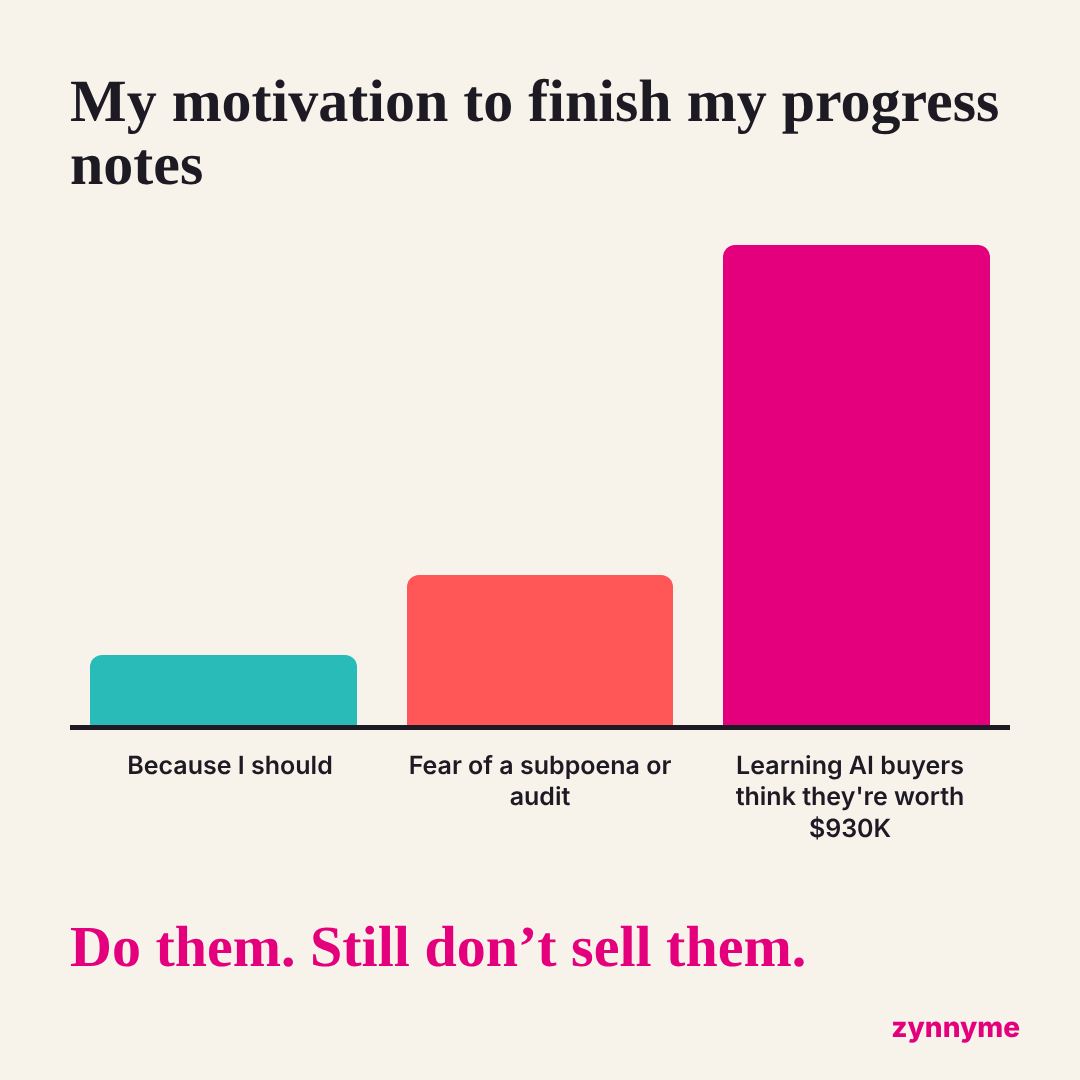
And, if you like dark humor and need a little chuckle or giggle to get you through your day… maybe if we realized how much our notes were worth- we’d stop getting behind on them.
Questions, comments, concerns? Join the conversation over on TikTok here. Looking for resources to help you unravel from this dystopian nightmare and put your focus back on solid clinical work? Tell us about your situation, and we can connect you to cool ways we can help.
References:
AlleyWatch: Protege raises funding for AI training data licensing (2026)
Accountable: HIPAA authorization required before any sale of PHI
Fitzpatrick Lentz & Bubba: De-identified patient information and HIPAA (2017)
HealthsystemCIO: Gartner on AI re-identification risk (2026)
Behavioral Health Business: Headway biometric verification (2026)